Friday, July 28, 2006

Worship Service or Pep Rally?

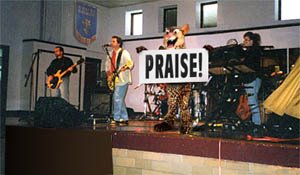
Maybe we've been going about things the wrong way. Maybe what we need isn't more Christ-centered worship or expositional preaching or even sound, biblical doctrine. Maybe what our churches need are more mascots. From the satirical LarkNews.com:
    MONTEREY, Calif. — First Nazarene Church used to start Sunday services with announcements and a generic welcome from the associate pastor. Now service starts with whirling spotlights, stadium music and a cougar mascot bounding down the center aisle slapping high fives and making "raise the roof" gestures.

    "Adding Christian Cougar was a great move for us," says the pastor. "No one calls our church boring anymore."

    Churches across the country are adopting mascots to pump up Sunday mornings and rally people in worship.

    "Our new mascot energizes things," says pastor Del Richards of Valley Baptist Church in Little Rock, Ark., which just introduced Lift-Him-Up Lion.

    On Sunday morning during worship time, the Lion rushes on stage and does the running man dance to "Blessed Be Your Name." He then makes "I can't hear you" motions and broad clapping gestures, then kneels with his hands raised when the songs turn slower. Worship team members play along with his antics. During the offertory he pulls out an oversized wallet and dumps wads of fake cash into the offering plate. During the sermon he stands to the side and makes rah-rah gestures and encourages people to applaud.

    "I tell him to go with the Spirit and raise some heaven," says the pastor. "By the time I get in the pulpit, the people are so amped up they can hardly contain themselves." ...

    ... Mascots are also an affordable option compared to larger projects.

    "We couldn't afford a new youth center, but we can afford a wolverine costume," says a Michigan pastor whose attendance has risen considerably since they added Worship Wolverine, who does trampoline flips, handstands and runs across the platform with a banner that says, "Praise!" ...

    ... Some churches experimented with live characters like Samson or the Apostle Paul, but people "thought they were weirdos or homeless people." Most stick with animals. (Full story)
Now, if people dressed up as animals can be used to get the congregation fired up for the Lord, just think of how much more excited people would be about going to church if we added cheerleaders!

Oh, that would be too much? I suppose. After all, we wouldn't want anything to take our focus off of Christ, now, would we? Unfortunately, looking at everything churches do to get people through the doors, we can't be too far away.

Friday, July 21, 2006

Should Christians Be Optimistic, Part III

I’m finally returning to the question of how Christians should view history, particularly the future.

I want to turn very briefly to the humiliation and sacrifice of our Lord and ponder just how it should change or shape our outlook of the future. Jesus suffered greatly, both as man and God, for the sins of His people.

First, he laid down His divine prerogatives to take the form of a humble servant. Paul writes that Jesus "made himself nothing, taking the form of a servant, being born in the likeness of men. And being found in human form, he humbled himself by becoming obedient to the point of death, even death on a cross" (Phil. 2:7-8)

Second, not only did Jesus die for us, He lived a perfect life for us, too, in the face of great temptation. As the Second Adam, Jesus had to face and overcome the temptations and machinations of Satan (Matt. 4:1-11; Mark 1:12-13; Luke 4:1-13). The author of Hebrews says that, "we do not have a High Priest who cannot sympathize with our weaknesses, but was in all points tempted as we are, yet without sin" (Heb. 4:15). Jesus had to face and conquer temptation on behalf of His people as a man, to win victory where Adam had fallen.

Third, in His physical being, Jesus had real, human, physical limitations. He hungered (Matt. 4:2), thirsted (John 19:28), and became physically tired (Mark 4:38). Additionally, Jesus had real human emotions. At various points, Jesus is described as troubled (John 12:27), sorrowful (Matt. 26:38), and compassionate (Mark 1:41).

Fourth, before going to the Cross, Jesus suffered slapping and scourging by His Roman tormentors and was mocked and cursed by His own kinsmen of the flesh. He endured harsh physical and emotional pain on our behalf.

Fifth, on the Cross, He became Sin for us. The Bible says that he became "a curse." "Christ redeemed us from the curse of the law by becoming a curse for us, for it is written: 'Cursed is everyone who is hung on a tree.'" As God, Jesus was without sin, and yet He willingly became sin to save His people from the coming wrath and judgment of God. "For our sake he made him to be sin who knew no sin, so that in him we might become the righteousness of God" (II Cor. 5:21).

Finally, Scripture says that the only begotten Son of God, who shared perfect fellowship as the second member of the Godhead, was forsaken by the Father. “And at the ninth hour Jesus cried with a loud voice, "Eloi, Eloi, lema sabachthani?" which means, "My God, my God, why have you forsaken me?” (Mark 15:34).

Christ's suffering begs the question, was it all in vain? Did Jesus do all of this so that only a small percentage of men would be saved? Did he suffer so that the world would fall increasingly under the reign of Satan? Moreover, is Jesus’ victory at the cross and His ultimate exaltation primarily, if not exclusively in the spiritual realm?

It seems reasonable to assume that because His suffering, humiliation, death, burial, and ultimate triumph occur in rather than outside histor--and as a real, physical man--that His ultimate victory likewise will be visible and on earth, in history, not as the result of a post-historical discontinuity.

W. G. T. Shedd puts it this way:

It is utterly improbable that such a stupendous miracle as the incarnation, humiliation, passion, and crucifixion of one of the Person of the Godhead, should yield a small and insignificant result. On a priori grounds, therefore, we have reason to conclude that the Gospel of the Cross will be successful, and the Christian religion a triumph on the earth and among the race of creatures for whom it was intended. But this can hardly be the case, if only a small fraction of the human family are saved. The presumption, consequently, is that the great majority of mankind not the small minority of it, will be the subjects of redeeming grace.

Thursday, July 13, 2006

What Is Most Damaging to the Body of Christ?

Marc Heinrich poses an interesting question on his site, Purgatorio: Which of the following is most damaging to the Body of Christ?:
    1. The Anglican's naming a woman Presiding Bishop who supports ordination of practicing gay clergy:

      Nevada Bishop Katharine Jefferts Schori became the first woman elected to lead a church in the global Anglican Communion when she was picked Sunday to be the presiding bishop of the Episcopal Church. ... In 2003, the Americans shocked the Anglican world by electing the first openly gay bishop—V. Gene Robinson of New Hampshire. Placing a female bishop at the head of the denomination may further anger conservatives overseas and within the U.S. church. And Jefferts Schori voted to confirm Robinson.

    2. The PCUSA's allowing the renaming of the Trinity to "compassionate mother, beloved child, and life-giving womb" instead of "Father, Son, and Holy Spirit":

      At the recent 217th General Assembly meeting, PC(USA) commissioners voted to allow the denomination's churches to use the phrase "compassionate mother, beloved child, and life-giving womb" instead of "Father, Son, and Holy Spirit" when referring to the Trinity. This was just one of the 12 phrases approved by the Assembly as permissible substitutions for the traditional names of the Godhead, another being "rock, cornerstone, and temple."

    3. The SBC's resolution on alcohol:

      RESOLVED, That we urge that no one be elected to serve as a trustee or member of any entity or committee of the Southern Baptist Convention that is a user of alcoholic beverages.

      RESOLVED, That we urge Southern Baptists to take an active role in supporting legislation that is intended to curb alcohol use in our communities and nation ...
While I believe all three positions are unbiblical, it is my contention that #3 (i.e., the issue of liberty vs. legalism) is the most damaging to the Body of Christ. Why do I say that? Because those churches who agree with #1 or #2 have already demonstrated that they are not part of the Body of Christ.

Monday, June 19, 2006

Is Old Testament Law Applicable Today?

Something that has been on my heart lately is the relevance of Old Testament Law: Does it still apply to us today? I hope to write more on this subject in the near future, but in the meantime, let me share some of my initial thoughts on the subject.

Whevever I hear someone talk about "God's Law"—in particular, calling for "God's Law" to be enforced in civil government—I find myself a bit confused. What exactly does that entail? What do they mean by "God's Law"? My concern is that what they are really pushing is an American theocracy.

Recently, I read an article that called for the state-sanctioned killing of homosexuals. "The word of God commands that sodomites are to be executed," the author writes, "and God gives our civil officials the sword to do the job. Until our civil officials turn from their wicked way by administering Justice, we can only be judged with the most depraved pagan nations in history." Welcome to life under theocratic rule.

One of the things that jumps out at me whenever I see a plea for a return to "God's Law" is the lack of clarification in defining the law. If honoring the law means adherence to the Old Testament, then what other laws should we enforce? Should a man who lies with a woman during her menstrual cycle be banished (Lev. 20:18)? Should women who aren't virgins be stoned to death (Deut. 22:20-21)? Should all adulterers be executed (Deut. 22:22)? Should we stone rebellious children (Deut. 21:20-21)? What's to be done with those who mar the edges of their beards (Lev. 19:27)? Should women who have just given birth be kept from attending church services for 33 days—66 if they give birth to a girl (Lev. 12:4-5)? And how should we lawfully and biblically deal with those who have bodily discharge (Lev. 15)?

How are we to determine which laws are to be enforced? Didn't James say that if we fail to keep the law in one point, we are guilty of breaking all of it (James 2:10)? I'm not saying that the Old Testament is irrelavant, but we must look at it in light of the New Testament.

For example, in the New Testament we learn that Christ, through his life, death, and resurrection, fulfilled the law (Matt. 5:17, Luke 24:44, John 15:25). We as Christians fulfill the law through love (Rom. 13:10). And Paul reminds us that "the whole law is fulfilled in one word: 'You shall love your neighbor as yourself'" (Gal. 5:14).

That, of course, isn't to say that we should be silent when it comes to the law. As we take Christ to the world, we preach the law so that people are convicted of their sin. But we also reach out to the lost in love by preaching the gospel. That's how individual lives, families, communities, nations, and the world are changed. No amount of legislating will do that.

A New Law
- from Mockingbird by Derek Webb


Don't teach me about politics and government
Just tell me who to vote for

Don't teach me about truth and beauty
Just label my music

Don't teach me how to live like a free man
Just give me a new law

I don't wanna know if the answers aren't easy
So just bring it down from the mountain to me

I want a new law
I want a new law
Gimme that new law

Don't teach me about moderation and liberty
I prefer a shot of grape juice

Don't teach me about loving my enemies

Don't teach me how to listen to the Spirit
Just give me a new law

I don't wanna know if the answers aren't easy
So just bring it down from the mountain to me

I want a new law
I want a new law
Gimme that new law

What's the use in trading a law you can never keep
for one you can that cannot get you anything
Do not be afraid
Do not be afraid
Do not be afraid

Monday, June 12, 2006

Should Christians Be Optimistic? Part II

In my previous post, I considered certain attributes of God's character and
His purposes that should incline Christians toward historical optimism.

Likewise, consider Jesus and His ministry. Christ came to earth to
accomplish the purpose of His Father in establishing the kingdom of God.

Before departing to the right hand of the Father, Jesus promised to empower
His disciples, and He gave them their marching orders. "All authority in
heaven and on earth has been given to me. Go therefore and make disciples
of all nations, baptizing them in the name of the Father and of the Son and
of the Holy Spirit, teaching them to observe all that I have commanded you.
And behold, I am with you always, to the end of the age" (Matt. 18:18-20).

After this, Jesus ascends to heaven and is enthroned at the right hand of
God. I've often wondered why I've never heard a single sermon on the
ascension and its significance. Not once in my entire life do I recall
having been taught about this doctrine. The reason, I've concluded, is
that it conflicts with the predominant eschatological framework of the
modern evangelical church. The idea that Jesus is king NOW and has been
given all authority in heaven and ON EARTH does not neatly comport with the
notion that the church will fail, and that Satan's authority and power will
increase over time.

Jesus has been exalted at the right hand of God and the promised Holy
Spirit was poured out on the church to empower it with gifts (Acts
2:30-36). Scripture affirms that Jesus will, indeed must, reign until he
has put ALL his enemies under his feet (I Cor. 15:25). But does this
victory occur through a catastrophic return, or is the process slow and
gradual with Jesus working out His will through His People?

Paul says that the Father "seated him [Jesus] at his right hand in the
heavenly places, far above all rule and authority and power and dominion,
and above every name that is named, not only in this age but also in the
one to come. And he put all things under his feet and gave him as head over
all things to the church, which is his body, the fullness of him who fills
all in all" (Eph. 1:19-23).

Jesus said to Peter, "I will build my church, and the gates of Hades will
not overcome it." Our Lord paints a picture of a militant and empowered
body of believers, with Jesus in the lead working through the Holy Spirit,
taking the Gospel into the world and scattering the darkness. It is the
forces of evil manning the barricades against the Church, not visa versa.

Thus, if Jesus has been given all authority, and has been made head of the
church, then He is responsible to bring the world into submission. Is it
possible that He will fail? And why would such a victory only come about
AFTER the church, the Body of Christ, has been raptured out of the world?

Having said that, let me offer a qualification. The kingdom of God has not
reached its ultimate fulfillment. There is indeed an "already, not yet"
dichotomy at work. However, is it not reasonable to expect that during the
period between inauguration and consummation there will be growth in the
kingdom of God?

When Jesus describes the Kingdom in His parables, he paints a picture of a
mustard seed sown in a field. "It is the smallest of all seeds, but when
it has grown it is larger than all the garden plants and becomes a tree,"
says Jesus (Matt. 13:31-33). Likewise the kingdom is like leaven that over
time permeates the entire loaf of bread. So the development is progressive
and slow, not catastrophic or in some sense post-historical.

This is not altogether different from a traditional understanding of
sanctification. There is a moment of definitive sanctification in the life
of the believer. However, the process of growing into Christ-likeness
takes place in history, on earth, practically in the life of the believer.
And though sin is not completely eradicated, it should wield less influence
over the believer. Why shouldn't this principle apply to the broader
context of God's kingdom?

Next time, I will briefly consider Christ's humiliation.

Friday, June 09, 2006

Should Christians Be Optimistic? Part I

As a Calvinistic Southern Baptist, it dawned on me recently how crabbed we sound when synthesizing our understanding of God's sovereignty, or decretive will, with historical pessimism.

Over the course of several brief posts, I would like to consider how our understanding of God's sovereignty, Christology, and Pneumatology should provide a framework for historical optimism.

First, let us consider some basic purposes of the Father. God has promised to bless the nations and all families of the earth. "Now the LORD said to Abram, 'Go from your country and your kindred and your father's house to the land that I will show you. And I will make of you a great nation, and I will bless you and make your name great, so that you will be a blessing. I will bless those who bless you, and him who dishonors you I will curse, and in you all the families of the earth shall be blessed'" (Gen. 12:1-3)

Second, the Father has promised to establish His Son's Kingdom over the whole earth (see Ps. 110). In Daniel 2, we read, "God of heaven will set up a kingdom that shall never be destroyed, nor shall the kingdom be left to another people. It shall break in pieces all these kingdoms and bring them to an end, and it shall stand forever."

Through Christ, the Kingdom of God comes to fruition. According to Isaiah there will be no end to the increase of His government, and from His throne justice and righteousness will be established and upheld.

We also know some other things about God’s attributes. In His dealings with man, God is gracious and merciful. "The LORD is gracious and merciful, slow to anger and abounding in steadfast love" (Ps. 145:8). Similarly, God takes no pleasure in the death of the wicked. "For I have no pleasure in the death of anyone, declares the Lord GOD; so turn, and live" (Ezek. 18:32; see also Ezek. 18:23).

On the other hand, we also know that God decrees EVERYTHING that comes to pass for His glory and pleasure (see Eph. 1:3-14). According to the London Baptist Confession (1689), "God hath decreed in himself, from all eternity, by the most wise and holy counsel of his own will, freely and unchangeably, all things, whatsoever comes to pass."

Does God’s decretive will, expressed above, come into conflict with his graciousness toward men? The primary eschatological approaches of the day, which tend toward historical pessimism, typically posit that the vast majority of mankind will be lost. But if God does not take pleasure in the deaths of men, why would he foreordain to punish the majority of them?

More to come...

Monday, June 05, 2006

Hexakosioihexekontahexaphobia

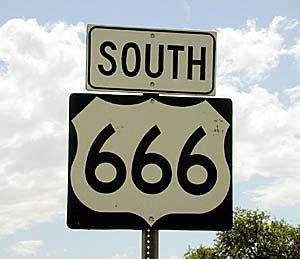
In case you forgot, tomorrow is June 6, 2006, or... (cue the theme music from The Omen) ...666!

Hexakosioihexekontahexaphobia (Does it really need to be explained?) is the fear of the number 666, and it has led to some silly reactions. You may recall that U.S. Route 666 was renamed to U.S. Route 491 back in 2003. And I know of one house not too far from my own home that had its address changed from 666 to 668.

Unfortunately, this irrational fear seems to be popping up in evangelical circles. Ambassadors Ministries, for example, is calling for a "violent day of worship" to combat the forces of evil:
    "We believe that the plans the enemy has for this date (June 6, 2006) will be destroyed through violent worship and praise. We are inviting the entire world to be part of this huge unity project."
Now, I could be wrong, but hasn't this particular date already come and gone 20 times over the last 2000 years?

Wednesday, May 31, 2006

Why Does Evil Exist?

Human beings are curious by nature, so it is understandable when people wonder why bad things happen. If there is a God, and if God is good, then why does evil exist? Surely there must be a reason.

To answer this question, we must first begin to understand the concept of God's sovereignty and holiness. I realize that's a bit like saying, "In order to put gas in your car, you must first learn how to build an internal combustion engine while blindfolded," but let's just touch on some of the basics.

What is the very first thing we learn in scripture? "In the beginning, God created the heavens and the earth" (Gen. 1:1). That's pretty straightforward. The Bible opens by saying that everything exists because of God. Naturally, there is the assumption that the Creator is in control of his creation. In other words, he has complete sovereignty.

Scripture teaches us that while God does not condone evil (Isaiah 13:11), he did ordain that evil exist. This has everything to do with his sovereignty. In fact, as we see in the book of Job, not even Satan can make a move without God's say-so.

God himself is not the sinner, nor does he act as an agent of sin. But he can and does intend sin for good. One example of this can be found in Genesis 50:20, where Joseph confronts his brothers who sold him into slavery: "As for you, you meant evil against me, but God meant it for good, to bring it about that many people should be kept alive, as they are today."

Note that Joseph didn't say that God used evil for good. He meant for evil to happen so that a greater good would come from it.

Perhaps the ultimate example of God ordaining evil for good is the sacrifice of his only son for our sins. The crucifixion of Jesus Christ was clearly an evil act committed by evil men—there is no other way to describe the execution of the most innocent person who ever lived—but Christ's death was predestined even before the world began (Acts 4:27-28, Eph. 1:5-7, 1 Pet. 1:18-20). And it is that sacrifice that has purchased eternal life for those who believe.

The blessed truth to be found here is that God is in control of all things (Deut. 32:39, Job 1:21-22, Isaiah 45:7, Amos 3:6, James 4:14-15). Everything that happens is in accordance with God's will. In Ephesians 1:11, the Apostle Paul writes, "In him we have obtained an inheritance, having been predestined according to the purpose of him who works all things according to the counsel of his will."

The sovereignty of God is absolutely fundamental. As Charles Spurgeon preached:
    There is no half way between a mighty God that worketh all things by the sovereign counsel of his will and no God at all. A God that cannot do as he pleases—a God whose will is frustrated—is not a God, and cannot be a God. I could not believe in such a God as that.
God is nothing if not sovereign.

God is also holy. He is perfectly good and just in every way. While it may at first seem like a contradiction for a holy God to even allow evil to exist, much less ordain it, the existence of evil helps us understand who God is. Let me explain.

As human beings, you and I long for that which is good. We want to do what is right. We strive constantly for something that is higher than we are. And there is nothing higher, more right, or more good than God. He is the epitome of purity and perfection. As such, he cannot help but bring glory to himself. To do anything less would be a sin—and God does not sin.

In short, the existence of evil allows God's glory to shine. The great American theologian Jonathan Edwards gives us a much more detailed explanation:
    It is a proper and excellent thing for infinite glory to shine forth. And for the same reason, it is proper that the shining forth of God's glory should be complete. That is, that all parts of his glory should shine forth, that every beauty should be proportionately radiant, that the beholder may have a proper notion of God. It is not proper that one glory should be exceedingly manifested and another not at all. Thus, it is necessary that God's awful majesty, his authority and dreadful greatness, justice, and holiness should be manifested. But this could not be unless sin and punishment had been decreed so that the shining forth of God's glory would be very imperfect, both because these parts of divine glory would not shine foth as the others do, and also the glory of his goodness and love and holiness would be faint without them. Nay, they could scarcely shine forth at all. If it were not right that God should decree and permit and punish sin, there could be no manifestation of God's holiness in hatred of sin or in showing any preference in his providence of godliness before it. There would be no manifestation of God's grace or true goodness if there was no sin to be pardoned, no misery to be saved from. How much happiness soever he bestowed he would not be so much prized and admired, and the sense of it would not be so great. So evil is necessary in order to the highest happiness of the creature and the completeness of that communication of God for which he made the world because the creature's happiness consists in the knowledge of God and the sense of his love. And if the knowledge of him be imperfect, the happiness of the creature must be proportionately imperfect.
So, why does evil exist? If I had to answer in a single sentence, I would say this: Evil exists because its inevitable defeat ultimately glorifies God.

Friday, April 21, 2006

On the Necessity of Christian Engagement

The Purpose of the Christian Life

Before getting too far ahead of ourselves, we should think about and define the purpose of the Christian life. The Westminster Catechism begins by saying that the chief end of man is to glorify God and enjoy Him forever. In other words, Christianity isn’t primarily about individual soul-saving, but glorifying the Creator of the cosmos.

Today, there is a tremendous need for Biblical evangelism that surpasses tract passing, personal testimony, and "Just As I Am." What is needed is a comprehensive program that brings the comprehensive message of salvation to every individual—and institution.

Evangelicals tend toward an extremely narrow view of God’s Kingdom and His purposes. What is the purpose of the Great Commission? Is it merely an edict to the Church to witness in a hopeless and dying world, snatching a few desperate souls from the fiery cauldron of the lake of fire? Or should Christ’s directive give us hope that the Holy Spirit will empower the Church to promote salvation against the world, the flesh, and the evil one?

In Matthew’s Gospel, Jesus asks His disciples the BIG question that we must all answer—"Who do you say I am?" Peter responds by saying, "You are the Christ, the Son of the Living God." Next, Jesus tells Peter that upon his confession, "I will build my church, and the gates of Hades will not overcome it." The picture painted by our Lord is of a militant and empowered body of believers, taking the light of the Gospel message into the world and scattering the darkness. It is the forces of evil manning the barricades against the Church, not visa versa.

Though Satan is a mighty enemy, described as a roaring lion, Scripture gives us comfort that in light of Christ's victory at Golgotha; the strong man has been bound, and we are to plunder his house (Matt. 12:29) and occupy it until Jesus returns.

Thankfully, we have not been left powerless to fulfill our mission. We have the Word of God, which is sharper than a two-edged sword, and access to God through prayer. Most importantly, we have Jesus’ promise that He will be with us always in the person of the Holy Spirit, who was sent to be our counselor and minister.

Aside from the purpose of the Great Commission, Evangelicals also frequently misunderstand its nature as well. Is it merely individualistic, with the hope of saving individual lost sinners and training them in their private "walk with God" and public worship? Or is its goal to transform individuals with the expectation that they will make a difference in the world, creating a Christian culture?

Discussing the perversion of the “individualistic” Gospel, Dr. David Alan Black writes:

One of the perversions of the Gospel I think needs eliminating today is the emphasis upon personal evangelism to the detriment or exclusion of any social emphasis. I do not question the fact that salvation is personal and individual, but it is far more than that. However, for many evangelicals the emphasis on the personal and individual has increasingly made salvation individualistic. The whole of the Christian experience is thought to be one’s personal relationship to God – often to the exclusion of one’s relationship with others or to the culture in general.

Salvation is both personal and social. Since sin is personal, each individual is guilty of sin and must be forgiven for his sin, not someone else’s. However, salvation is also social. Jesus is Lord of all. Politics, education, economics, the arts – all these are included under His divine Lordship. Thus Christians must come to understand that although salvation is individual and personal, the kingdom of God is far broader than just our personal salvation experiences.


It is true, as Dr. Black says, that sin is personal, as are the consequences, and the regenerating work of the Holy Spirit is the starting point for Christians. Those who are dead in trespasses and sins (Eph. 2:1) must be given a new heart and a new spirit. The Apostle Paul tells us "the sinful mind is hostile to God. It does not submit to God’s law" (Rom. 8:7).

Regeneration, however, is just the beginning. In Christ, we become a new creation and are prepared to accomplish the good works for which we were created (Eph. 2:10). We are dead to sin, and slaves to Christ. In the strength of the Holy Spirit, we also have the ability to obey the commands of the King, and we are obligated to do so out of love (John 14:15, I John 2:3-5). The theological term for this growth process is progressive sanctification. In effect, we become more Christ-like in our attitudes and actions. This process of progressive growth ought to be foundational to any Christian strategy of cultural and political activism. In other words, the transformation of individuals must precede the transformation of institutions and culture.

Discerning God’s Will

The "purpose driven life" is a life lived seeking conformity to the will of God. But what is God’s will for us? D. James Kennedy writes, "God's answer to the question of human purpose and meaning centers around two great mandates He has given us in His Word. A mandate, of course, is a directive or command that points us in a specific direction." Those two mandates are the Cultural Mandate, given at the creation of man, and the Great Commission, given with the creation of the new man.

The first of God's two mandates - the Cultural Mandate - is found in Genesis 1:26-28:

Then God said, "Let Us make man in Our image, according to Our likeness; let them have dominion over the fish of the sea, over the birds of the air, and over the cattle, over all the earth and over every creeping thing that creeps on the earth." So God created man in His own image; in the image of God He created him; male and female He created them. Then God blessed them, and God said to them, "Be fruitful and multiply; fill the earth and subdue it; have dominion over the fish of the sea, over the birds of the air, and over every living thing that moves on the earth."


Nancy Pearcey says that to "'be fruitful and multiply,' means to develop the social world: build families, churches, schools, cities, governments, laws. The second phrase, 'subdue the earth,' means to harness the natural world: plant crops, build bridges, design computers, compose music. This passage is sometimes called the Cultural Mandate because it tells us that our original purpose was to create cultures, build civilizations—nothing less."

Here we see the Trinity conferring upon man the role of vice-regent, ruling and reigning with God, bringing the world under His dominion. Man’s task in accordance with God’s command and our own nature, having been created in His image, is to exercise dominion and develop culture. As a "federal head," Adam did not merely act on his own behalf, but as a representative for all of mankind. The command to Adam, which is stated again in the Noahic Covenant (Genesis 9) is still in force today. To quote Kennedy again, "As the vice-regents of God, we are to bring His truth and His will to bear on every sphere of our world and our society. We are to exercise godly dominion and influence over our neighborhoods, our schools, our government, our literature and arts, our sports arenas, our entertainment media, our news media, our scientific endeavors - in short, over every aspect and intrusion of human society."

Adam’s fall into sin was imputed to all humanity and perverted the God-given desire to exercise authority in God’s name, and replaced it with a desire to become God ourselves. Consequently, Christ’s representative and vicarious death was necessary to restore and renew the image of God to allow redeemed men to bring the creation into submission to God. It is only in Christ, through the power of the Holy Sprit, that man can fulfill his original mandate. Thus, there is an intimate connection between the Great Commission and the Cultural Mandate, for without salvation, we can do nothing. Therefore, evangelism and discipleship takes precedence over other activities.

However, as Christians our duty is not simply to fill our churches and drag new converts into the baptistery. We are to make disciples for our Lord, and teach them to obey everything God has commanded.

True Christian discipleship recognizes that every sphere of life is under the authority of God, and Christ’s salvation and healing is not merely for individuals, but also for the creation that groans under the impact of sin (Rom. 8). As Gary North has written, "Nothing is to be excluded from Christ’s healing: not the family, not the State, not business, not education, and surely not the institutional church. Salvation is the salve that heals the wounds inflicted by sin: every type of wound from every type of sin."

Too many of my fundamentalist and evangelical friends (and I would claim to be both an evangelical and a fundamentalist) think that Christians must merely preach the Gospel, bring souls to Jesus, and everything else will simply fall into place. But this is a denial of a Christian worldview. Chuck Colson writes:

The only task of the church, many fundamentalists and evangelicals have believed, is to save as many lost souls as possible from a world literally going to hell. But this [is an] implicit denial of a Christian worldview. It is unbiblical and [it] is the reason we have lost so much of our influence in the world. Salvation does not consist simply of freedom from sin; salvation also means being restored to the task we were given in the beginning—the job of creating culture.


We must also recognize that God created the world and called it good. Thus, though contaminated by man’s sin, the created order is still good, and the redeemed in Christ are called by God to work toward restoring the world to a Godly order.

What Has This Got to do With Politics?

Thus far, I have attempted to demonstrate that the purpose of the Christian life is to pursue God’s glory in obediently seeking to fulfill the Great Commission and the Cultural Mandate. But what has any of this to do with politics?

The word politics comes from the Greek word "polis", meaning the state or community as a whole. Politics is the means of organizing a just, equitable, and peaceful society by providing mechanisms to resolve conflicts that arise between men, by means of discussion and rational compromise. Politics is not feasible without government and authority.

However, for Christians, Christ has been given all authority in heaven and on earth, and the government, all government, rests upon His shoulders. The Scripture is clear that Christ holds all things together and through Him, all things will be reconciled to the Father. "He is the image of the invisible God, the firstborn over all creation. For by him all things were created: things in heaven and on earth, visible and invisible, whether thrones or powers or rulers or authorities; all things were created by him and for him. He is before all things, and in him all things hold together. And he is the head of the body, the church; he is the beginning and the firstborn from among the dead, so that in everything he might have the supremacy. For God was pleased to have all his fullness dwell in him, and through him to reconcile to himself all things, whether things on earth or things in heaven, by making peace through his blood, shed on the cross" (Col 1:15-20).

When Paul says "all things" does he really mean all things except politics, economics, literature, and culture? Similarly, when Paul says that we are to take every thought and make it captive to Christ (I Cor. 10:5), does that exclude politics? When he writes that we must do all things to the glory of God (I Cor. 10:31) does Paul really mean "all things other than politics?"

Also, Jesus says that His people are the salt of the earth and the light of the world, and the rule and reign of Christ is extended by His people. Christians perform a common grace function. Our presence serves as a preservative and a light scattering the darkness. Does God desire justice, equity and peace and is He the source of those blessings? If so, why would it make sense that His followers and disciples should flee the battlefield and leave society in the hands of humanists?

The Bible describes believers as exiles in the world (I Peter 1:17, I Peter). Typically, my brothers and sisters use that passage to defend obscuratinism and retreat from the culture. "We're just passin' through, 'cause our citizenship is in heaven," they say. At the same time, they recite the Lord’s Prayer and sing "This is our Father’s world" without any recognition of cognitive dissonance.

Christians are indeed exiles in this world, captives if you will (I Peter 1:17, I Peter 2:11, etc.). So how do we seek dominion at the same time that we are "exiles?" Dominion is achieved primarily by service. Jesus, King of Kings, came to be a servant, and as His disciples we are to be conformed to His image and follow His example. But it is through true servanthood that dominion is established. Writing to the Jews is captivity, Jeremiah explains what it means to be an exile:

4This is what the LORD Almighty, the God of Israel, says to all those I carried into exile from Jerusalem to Babylon: 5 "Build houses and settle down; plant gardens and eat what they produce. 6 Marry and have sons and daughters; find wives for your sons and give your daughters in marriage, so that they too may have sons and daughters. Increase in number there; do not decrease. 7 Also, seek the peace and prosperity of the city to which I have carried you into exile. Pray to the LORD for it, because if it prospers, you too will prosper. (Jer. 29:4-7)"


This sounds strikingly like the Cultural Mandate—have babies, build houses, till the soil and grow crops, seek prosperity and wealth. This is the heart of loving God with our whole being and loving our neighbors.

What is Government?

Modern man frequently makes the error of equating "government" with the State. The Cambridge Dictionary defines government as "the group of people who officially control a country." In fact, government belongs to God. He has established numerous "governments" with various prerogatives and powers to advance His holy purposes.

For example, God created the family as the primary source of earthly government. The family, has been given stewardship over children, authority over property and inheritance, and control over education. The family is also the institution preeminently responsible for social welfare. Paul says that the failure to care for our own marks us as "worse than an unbeliever" (I Tim. 5:8) and James says that "pure and undefiled religion…is this: to visit orphans and widows in their trouble" (James 1:27).

The early church did not depend on the Roman civil authorities to meet social needs. Likewise, we see Jesus on the cross with His dying words ensuring that His mother is taken care of by John (John 19:25-27). The modern State has encroached into all these areas that rightly fall under the purview of family government. Strong and stable families, jealously guarding their prerogatives, are the foundation of strong and stable communities, and only these mediating institutions can protect the naked individual from the maniacal, power-hungry State.

There are other "governments" as well, foremost among them, the school and the church. The point here is a simple one – God has established various institutions and given them responsibilities in their spheres of influence. More importantly, the jurisdiction of these institutions has been limited and circumscribed by the Scriptures.

Christians need to realize that the State is not sovereign. Only God is absolutely sovereign. All human agencies have limited degrees of authority. Scripture tells us that all power and authority reside in the resurrected and ascended Christ who is enthroned at the hand of God (Matt. 28:18) and that it is in Christ that all things are held together (Col. 1:17). The institutions created by Him are to serve as His ministers, working out His will.

The State’s power is also limited and circumscribed by the Word. According to the Bible, God established civil government for three primary reasons:

1. To protect human life that is made in the image of God: "Whoever sheds the blood of man, by man shall his blood be shed; for in the image of God has God made man" (Gen. 9:6);

2. To defend the law-abiding from lawbreakers: "For rulers hold no terror for those who do right, but for those who do wrong. Do you want to be free from fear of the one in authority? Then do what is right and he will commend you. For he is God’s servant to do you good. But if you do wrong, be afraid, for he does not bear the sword for nothing. He is God’s servant, an agent of wrath to bring punishment on the wrongdoer" (Rom. 13:3-4);

3. To provide for a peaceful, orderly society: "I urge, then, first of all, that requests, prayers, intercession and thanksgiving be made for everyone-- for kings and all those in authority, that we may live peaceful and quiet lives in all godliness and holiness" (I Tim. 1:1-2).


Today, however, the State has usurped virtually all power to its bosom. Historically, the State has been an object of worship, God walking on earth, as Hegel says. Rushdoony has written that the state is intrinsically religious, "Every state or social order is a religious establishment. Every state is a law order, and every law order represents an enacted morality, with procedures for the enforcement of that morality. Every morality represents a form of theological order, i.e., is an aspect and expression of a religion."

Is there any doubt that a cosmopolitan, anti-Western, and vigorously anti-Christian elite has established control of virtually every viable institution, including the instruments of cultural dissemination and political control (i.e., the State)? Is there any question that said elite is an ally of humanism? Should such a state of affairs be endorsed or accepted by God’s people?

Many Christians point to Romans 13 as a proof text for inaction, or even retreat in political and cultural matters. However, I think these texts are frequently misunderstood in such a way as to leave the State free to rampage about in an unbiblical way. Paul says, "there is no authority except that which God has established. The authorities that exist have been established by God" (Rom. 13:1). So even the State is established and ordained by God for the purpose of being God’s servant (deacon) "to do you good" (v. 4). In other words, the State is also under the authority of God, accountable to Him, and must rule in accordance with His divine rule as revealed in Scripture. The Church, therefore, must prophetically proclaim the Lordship of Christ in all spheres of life, and as a Christian who takes God’s Word seriously, I have an affirmative duty to speak and toil for the establishment of a social order that takes God’s law-word seriously.

Thursday, April 13, 2006

Perversive Proselytization

Isn't it irritating when religious zealots try to force their beliefs on you? Just take a look at this.

Wednesday, March 29, 2006

Setting a New Standard (Literally) for End-Times Hysteria

Thanks to Marc at Purgatorio for finding this:
    The End-Times Christian Flag
    (a.k.a., The End-Times Battle Standard)


    This God inspired design was given to Pete Nelson in a vision in 2000. The purpose of this design was to create and end-time "battle standard" (flag) for the believers of Jesus Christ. It is not a traditional, denominational or "static" flag. This flag is meant to unite the Body of Christ as a mighty Army of God and reaffirm that Jesus is alive and will soon return. ...

    ... The "End-Times" flag is for believers and churches that are dedicated to attacking the strongholds of the enemy (satan), setting the captives free, and advancing the Kingdom of God.
Forgive me if I'm wrong, but aren't believers already united by virtue of Christ's death and resurrection (Rom. 6:5)? Are we to assume that the Gospel of Jesus Christ isn't enough to motivate us, that we need a new "inspired" symbol to bolster our faith?

Rather than rally around a piece of cloth, let's turn to scripture. As the Apostle Paul writes in Romans 15:4-6, "For whatever was written in former days was written for our instruction, that through endurance and through the encouragement of the Scriptures we might have hope. May the God of endurance and encouragement grant you to live in such harmony with one another, in accord with Christ Jesus, that together you may with one voice glorify the God and Father of our Lord Jesus Christ."

I can appreciate the creative effort that went into making this flag, but nothing can unite, inspire or encourage like the living Word of God.

Friday, March 24, 2006

Blessed Are the Warmongers

"Blessed are the peacemakers, for they shall be called sons of God" (Matt. 5:9)


Prior to the Iraq imbroglio, Richard Land compared war in a Iraq to a summertime skirmish against mosquitoes: "If you're going to deal with terrorists you can't just swat them or use insect repellent. You have to drain the swamp. Saddam Hussein is one of the major swamps. The U.S. would be doing the world a favor and acting in the best interest of future citizens of the U.S. by removing Saddam from power."

Leaving aside the fact that there was no working or collaborative relationship between the Iraqi regime and al-Qaeda, when a leading Christian ethicist can compare warfare with pest extermination, one wonders if all moral sense is lost.

Dr. Land is no backwater preacher. Educated at Princeton and Oxford, Land was called "God's Lobbyist" by Time magazine and has served as president of the Southern Baptist Convention's Ethics & Religious Liberty Commission since 1988. In that role, Land is perhaps America's most prominent Southern Baptist among movers-and-shakers in the New York-Washington corridor. He also played a prominent role among Evangelical Christians defending the Iraq war on Just War Theory grounds.

Well, it turns out that draining swamps is pretty dangerous work. So far the tally in Iraq is 2300+ dead American servicemen and more than 17,000 wounded. Unlike prior conflicts, the Pentagon has been unwilling to discuss Iraqi casualties, leaving it to independent researchers and journalists to come up with numbers. The website Iraq Bobycount puts the number of dead Iraqis between 33,000-37,000. In 2004, the medical journal Lancet put the number at 100,000, and recently, Andrew Cockburn used more sophisticated statistical analysis to arrive at a whopping 180,000. Throw in the $350 billion that has been spent so far and we've really got ourselves a good ole' swamp-drainin'.

With leaders like Dr. Land blazing away, Evangelicals have been the political foot soldiers and enablers of preemptive war in Iraq. In October 2002, nearly 7 in 10 "conservative Christians" favored military action against Iraq and despite some slippage, there remains strong support for administration policy in the Middle East. According to a recent Gallup poll, just 16 percent or Republican churchgoers who attend services once a week thought the war was a mistake.

My own denomination, the SBC, passed a resolution last June expressing "deepest gratitude and respect for our president," who "has been forced to make difficult decisions that place our servicemen and servicewomen in harm's way." Southern Baptists are also encouraged "to pray regularly for our president and to stand with him in opposing global terrorism." Presumably the admonition excludes imprecatory Psalms, though the resolution was unclear on that matter.

Clearly, Christians do have certain obligations to civil authorities. We should indeed pray for our leaders (I Tim. 2:1-2), honor their God-ordained office (I Peter 2:17, Rom. 13:7), pay taxes (Rom. 13:6-7, Matt. 22:15-21), and obey their lawful commands (Rom. 13:5, Titus 3:1).

However, I think these texts are frequently misunderstood in such a way as to leave the State free to rampage about in an unbiblical way. Paul says, "there is no authority except that which God has established. The authorities that exist have been established by God" (Rom. 13:1). So even the State is established and ordained by God for the purpose of being God’s servant (deacon) "to do you good" (v. 4). In other words, the State is also under the authority of God, accountable to Him, and must rule in accordance with His divine rule as revealed in Scripture. But Scripture accords the State a very limited role, as I have argued elsewhere. "Swamp-draining" in the name of nation-building cannot be defended from Scripture.

Likewise, the duty to pray for civil leaders is indeed an affirmative command. But Paul’s point writing in the first century is that we are to pray FOR rather than TO such men. His admonition to Christians living in an age where the State frequently became God was to worship Christ rather Caesar. In short, Romans 13 must not devolve into Revelation 13.

Christians also don't read on to figure out why we are supposed to pray for our leaders. The purpose, says Paul, is that "we may lead a peaceful and quiet life." Surely living in the grip of perpetual war doesn't qualify as a peaceful and quiet life. Furthermore, it is undeniable that Christian missionaries will have a far more difficult time evangelizing in Islamic nations because of the actions of the American government and native Christians will face increasing hostility in their Islamic homelands.

There is another theological problem driving Evangelical war fever. Christians, particularly my Calvinist brethren, will argue until they are blue in the face that man is totally depraved, incapable of responding to God without the regenerating work of the Holy Spirit. Even in Christ, the Apostle Paul speaks in Romans 7 of our continual struggle with sin.

Throughout Scripture, civil leaders behave in ungodly ways. Exodus 1:18-21 records the account of Pharaoh commanding the Israelite midwives to kill every Jewish boy. Daniel 3 tells the story of Shadrach, Meschach and Aded-Nego and their defiance of the king when commanded to worship a false God. In Acts the disciples are arrested for preaching the Gospel. In Revelation, it is clear that "The Beast" becomes incarnate in a State.

Likewise, in today’s world, Christians have no trouble affirming that there is evil that cannot be reasoned with. Savage butchery in Rwanda or Sudan; the murderous rampages of Hitler, Stalin, Mao, and Pol Pot; such savagery singes our consciences and Christians know that such evil lurks in the heart of man because of sin.

Yet we are completely unwilling to look in the mirror. We can’t consider the possibility that our own elites have become so thoroughly corrupted and sinful that they could engage in similar behavior. Instead, Christians are perfectly willing to centralize authority in the executive branch at the expense of the legislature, in contravention of the vision laid out by the founders, and quite frankly standing in opposition to a Christian understanding of original sin.

To take one example, Leon Podles, writing for the editors of Touchstone Magazine, wrote that Christians "can decide their government is in error and that a given war is unjust" but "the presumption is that a democratically elected government is well-intentioned." According to Podles, we should forget the Maine, the Lusitania, the Gulf of Tonkin, Wilson's promise to stay out of WWI, or Roosevelt's solemn pledge to stay out of bloody European wars. All of this and much, much more must be scuttled down the memory hole, post-haste.

Likewise, most Christians seem willing to ignore allegations of torture, warrantless search and seizure, illegal wiretappings, prison without a fair trial or any trial, and a war built on a façade of false pretenses in order to prop up a Christ-professing president and his political party. Because they have bought the GOP's empty rhetoric on abortion and other social issues, Evangelical voters have become the primary political instrument wielded by the Republican establishment, a rent-a-mob that ultimately becomes a vehicle to foster globalism and meddlesome interventionism—the very ingredients producing the Islamist backlash.

Thursday, March 16, 2006

"Do-It-Yourself" Abortions

Thanks to the miracle of of the Internet, you too can be an abortionist. And you don't even need a medical degree!

"Molly" explains the entire procedure in detail on her blog:
    The first step is to break the membrane holding the fetus inside. You can feel around with the forceps for it. To get an idea of what each part looks like—and to see the texture so that you understand better how it will feel—I recommend looking at books with photographs of first trimester fetuses (personal recommendation for its astonishing photographs: A Child is Born), The membrane should be easily broken with the forceps. Depending on how far along the pregnancy is, varying quantities of clear or pinkish fluid may come from the vagina. As you grasp the sac with your forceps, twist it away so that it detaches. You will now need to remove small pieces of fetal material and membrane from the uterus with the forceps. Some of these pieces will be distinctly identifiable as fetal material. Save the material until the end of the procedure on a piece of plastic, so that you can be sure the entire fetus has been removed. If doing this sounds too ethically challenging, remember that fetuses do not have the capacity to feel actual pain until the third trimester. You are not "hurting" it, and it has no awareness, nor the capacity for awareness, that you are extracting it.
It is truly a sad day when women start turning to online blogs to learn how to kill their children in the convenience of their own home. Have we really reached that point? If the idea of parenthood (yes, I'm including the men on this) is so repugnant to some people, why jump into bed in the first place? Are a few moments of pleasure worth all this trouble?

And why resort to a "do-it-yourself" abortion? Wouldn't it be easier to just wait until right after the baby is born? Oh, but wait...that would be murder. It has to be ripped apart in utero for it to be considered "civilized."

Take it from someone who is in the process of adopting. These children that are being disposed of are wanted. Perhaps not by the men and women who created that life, but by people willing to give them loving homes.

For more on the significance of the act of abortion itself, see my essay "An Unholy Sacrament for an Inhuman Race."

Wednesday, March 08, 2006

The Importance of Expository Preaching

We live in a time when most evangelical churches are shaping their worship services to satisfy the tastes of the "unchurched." Many pastors have given up communicating the gospel of Christ and have become glorified motivational speakers whose main objective is to make people feel good about themselves.

Dr. Al Moehler has written a three-part series on the importance of expository preaching:We can never be reminded enough of just how central the Word of God is to the way we worship, the way we fellowship and the way we live.

Thursday, March 02, 2006

Left Behind: The Video Game

Do you have trouble getting your kids to read? Never fear! The same bad theology you have come to expect from Tim LaHaye and Jerry Jenkins will soon be available in an exciting, fun-filled, action-packed video game!

Introducing Left Behind: Eternal Forces, a real-time strategy game for your PC.

Don't get left behind. Pre-order your copy today!
Related Posts with Thumbnails