
Friday, September 28, 2007
This Week in Calvinism - September 28, 2007


Sunday, September 23, 2007
Tiptoeing through the TULIPs - Part 1: Total Depravity
Just mentioning the term "Calvinism" is enough to stir up controversy. It is seen by many as a cruel and unforgiving philosophy, and trying to have a reasoned discussion about it usually means having to navigate a theological minefield. It is, however, an important discussion, and we should not shy away from it.
What makes it so important? Charles Spurgeon once said, "I have my own opinion that there is no such thing as preaching Christ and him crucified, unless we preach what nowadays is called Calvinism. It is a nickname to call it Calvinism; Calvinism is the gospel, and nothing else."
This is not to say that one must be converted to Calvinism and have an in-depth understanding of the doctrines of grace in order to be saved. No true Calvinist would ever say that. But I do believe that studying these doctrines as they are taught in scripture is an important part of spiritual growth.
These doctrines are so interconnected that I think it's impossible to deny one without undermining all the rest. I believe these doctrines are biblically sound and can greatly affect all aspects of our lives: how we view God, how we see ourselves, how we treat others, how we worship, how we evangelize, and so on. What's more, they serve to glorify God -- and that is our ultimate goal.
Countless theologians over the years have explained, illustrated, discussed, and debated the five main pillars of Calvinism: total depravity, unconditional election, limited atonement, irresistible grace, and perseverance of the saints, otherwise known as "TULIP." Needless to say, what I am about to present here is nothing new. What I do hope to accomplish in this series of posts is to present you with my own personal understanding of these concepts as well as how they affect our lives as believers.
Total Depravity
Human beings were created in the image of God (Genesis 1:27). But what had been declared good became marred by sin with the fall of Adam and Eve. Because Adam was the representative of all mankind, every person since then has been born into sin (Romans 5:12, 1st Corinthians 15:22).
 While this does not mean that all people are as evil as they could possibly be, it does mean that "all have sinned and fall short of the glory of God" (Romans 3:23). The Apostle Paul reminds us that we, in our rebellious state, are completely incapable of pleasing God: "As it is written: 'None is righteous, no, not one; no one understands; no one seeks for God. All have turned aside; together they have become worthless; no one does good, not even one.'" (Romans 3:10-12). He expands on that in Ephesians 2:1-4, saying that even we believers were once "dead" in trespasses and sin, and that we "were by nature children of wrath, like the rest of mankind."
I believe the concept of total depravity correctly and biblically conveys the state in which we all find ourselves. No matter what we do, we cannot help but sin, "For whatever does not proceed from faith is sin" (Romans 14:23). We are fallen creatures in rebellion against our Creator, and our depravity is the constant reminder that we are in need of a savior. In fact, that was the purpose of the law.
Paul writes in Romans 5:20 that "the law came in to increase the trespass." In other words, God's law exposes our sinfulness. Matthew Henry, in his commentary on Romans, says, "The moral law showed that many thoughts, tempers, words, and actions, were sinful, thus transgressions were multiplied. Not making sin to abound the more, but discovering the sinfulness of it, even as the letting in a clearer light into a room, discovers the dust and filth which were there before, but were not seen."
We cannot understand the need for salvation until we first understand that we are lost. Once God bestows upon us salvation by his grace through faith in his son, we can reflect on our depraved human nature as we strive to grow in that faith.
One effect of this can be seen in our relationships with other people. If we recognize our own depravity, it is easier to show grace to those who hurt us. Likewise, when we hurt others, we will see the need to repent and ask for forgiveness. Speaking from experience, I can say that this is extremely helpful in marriage.
Most importantly, our walk with Christ will be more meaningful and intimate because we will know that we are nothing without him. Total depravity lays everything on the line and puts us in our proper place before a holy and just God. It also magnifies the incredible significance of his mercy "in that while we were still sinners, Christ died for us" (Romans 5:8). What better reason could we have for rejoicing in worship and telling others about the gospel?
Part 1: Total Depravity
Part 2: Unconditional Election
Part 3: Limited Atonement
Part 4: Irresistable Grace
Part 5: Perseverance of the Saints
What makes it so important? Charles Spurgeon once said, "I have my own opinion that there is no such thing as preaching Christ and him crucified, unless we preach what nowadays is called Calvinism. It is a nickname to call it Calvinism; Calvinism is the gospel, and nothing else."
This is not to say that one must be converted to Calvinism and have an in-depth understanding of the doctrines of grace in order to be saved. No true Calvinist would ever say that. But I do believe that studying these doctrines as they are taught in scripture is an important part of spiritual growth.
These doctrines are so interconnected that I think it's impossible to deny one without undermining all the rest. I believe these doctrines are biblically sound and can greatly affect all aspects of our lives: how we view God, how we see ourselves, how we treat others, how we worship, how we evangelize, and so on. What's more, they serve to glorify God -- and that is our ultimate goal.
Countless theologians over the years have explained, illustrated, discussed, and debated the five main pillars of Calvinism: total depravity, unconditional election, limited atonement, irresistible grace, and perseverance of the saints, otherwise known as "TULIP." Needless to say, what I am about to present here is nothing new. What I do hope to accomplish in this series of posts is to present you with my own personal understanding of these concepts as well as how they affect our lives as believers.
Total Depravity
Human beings were created in the image of God (Genesis 1:27). But what had been declared good became marred by sin with the fall of Adam and Eve. Because Adam was the representative of all mankind, every person since then has been born into sin (Romans 5:12, 1st Corinthians 15:22).
 While this does not mean that all people are as evil as they could possibly be, it does mean that "all have sinned and fall short of the glory of God" (Romans 3:23). The Apostle Paul reminds us that we, in our rebellious state, are completely incapable of pleasing God: "As it is written: 'None is righteous, no, not one; no one understands; no one seeks for God. All have turned aside; together they have become worthless; no one does good, not even one.'" (Romans 3:10-12). He expands on that in Ephesians 2:1-4, saying that even we believers were once "dead" in trespasses and sin, and that we "were by nature children of wrath, like the rest of mankind."
I believe the concept of total depravity correctly and biblically conveys the state in which we all find ourselves. No matter what we do, we cannot help but sin, "For whatever does not proceed from faith is sin" (Romans 14:23). We are fallen creatures in rebellion against our Creator, and our depravity is the constant reminder that we are in need of a savior. In fact, that was the purpose of the law.
Paul writes in Romans 5:20 that "the law came in to increase the trespass." In other words, God's law exposes our sinfulness. Matthew Henry, in his commentary on Romans, says, "The moral law showed that many thoughts, tempers, words, and actions, were sinful, thus transgressions were multiplied. Not making sin to abound the more, but discovering the sinfulness of it, even as the letting in a clearer light into a room, discovers the dust and filth which were there before, but were not seen."
We cannot understand the need for salvation until we first understand that we are lost. Once God bestows upon us salvation by his grace through faith in his son, we can reflect on our depraved human nature as we strive to grow in that faith.
One effect of this can be seen in our relationships with other people. If we recognize our own depravity, it is easier to show grace to those who hurt us. Likewise, when we hurt others, we will see the need to repent and ask for forgiveness. Speaking from experience, I can say that this is extremely helpful in marriage.
Most importantly, our walk with Christ will be more meaningful and intimate because we will know that we are nothing without him. Total depravity lays everything on the line and puts us in our proper place before a holy and just God. It also magnifies the incredible significance of his mercy "in that while we were still sinners, Christ died for us" (Romans 5:8). What better reason could we have for rejoicing in worship and telling others about the gospel?
Part 1: Total Depravity
Part 2: Unconditional Election
Part 3: Limited Atonement
Part 4: Irresistable Grace
Part 5: Perseverance of the Saints
Friday, September 21, 2007
This Week in Calvinism - September 21, 2007
Friday, September 14, 2007
This Week in Calvinism - September 14, 2007
Thursday, September 13, 2007
Smoking and Legalism
Steve Camp's excellent post on smoking and legalism sparked some interesting discussion on his blog. You can read it here.
Wednesday, September 12, 2007
Nietzsche Finds His Niche...
...in the Keane household, of all places.
This humorous little web site "pairs a randomized Family Circus cartoon with a randomized Friedrich Nietzsche quote."

Come on. A cheery, family-friendly cartoon merged with the dark, disturbing musings of a German philosopher? How could that not be funny?
This humorous little web site "pairs a randomized Family Circus cartoon with a randomized Friedrich Nietzsche quote."

Come on. A cheery, family-friendly cartoon merged with the dark, disturbing musings of a German philosopher? How could that not be funny?
Tuesday, September 11, 2007
A Burning Question for Arminians
One of the blessings of the Internet is having a vast collection of Reformed and Calvinist resources at my fingertips. I have made many online friends over the years who have inspired me in my walk with Christ and whose words of encouragement have helped me in all areas of my life. It's also a comfort to know that so many other people out there, both Calvinist and Arminian, wrestle with difficult issues as they travel on their own spiritual journeys, actively seeking the precious truths found in God's word.
Alas, there is a downside to this virtually unregulated medium. Anyone can get a web site or a blog and say just about anything with an air of authority they wouldn't otherwise have in the "real" world. (Hey, I'm living proof of that.) And that usually means one must sift through tons of dirt and mud (and venom and bile) to find a single nugget of wisdom.
Don't get me wrong. I love controversy as much as the next guy. In fact, I had an hour-long discussion with two Mormon "elders" just the other night who stopped their bikes to try and convert me as I was taking out the trash. (They eventually gave up in frustration and rode off, saying that it was clear I didn't even believe the Bible, and that I was wasting their time!) But much of the controversy found on the World Wide Web comes from Christian bloggers in what can only be described as a misguided (and in many cases, I'm willing to grant, unintentional) attack on some of the fundamentals of the Christian faith.
Like the Remonstrants of old, these bloggers are lashing out in ignorance against certain teachings in scripture because they can't make sense of them from a human perspective. "A God who chooses some people for salvation and not others? That isn't fair! My God is a God of love! And what do you mean that God ordained sin to enter into the world and that he causes bad things to happen? My God is not the author of sin! My God is not evil!" On and on they ramble, never seeming to tire of setting up Calvinist straw men and knocking them down in righteous indignation.
It is the issue of God's sovereignty with which they seem to have the biggest problem. Oh, they will readily agree that God is sovereign over all creation, but they will be just as quick to criticize a brother or sister who talks of a God who turns hearts toward hatred (Psalm 105:25), who means evil for good (Genesis 50:20), or who molds all people for his own purposes (Romans 9:21-23).
Unfortunately, they don't stop at mere criticism. Many go on to make the outrageous claim that we Calvinists believe in an evil God. They would agree with Dr. Roger Olson, professor of theology at George W. Truett Theological Seminary, who said, "The God of Calvinism scares me; I'm not sure how to distinguish him from the devil."
Which brings us to the issue at hand.
Imagine the following situation: I'm out for an evening stroll when I smell something burning. I look around and notice flames in one of the second floor windows of a neighbor's house. In the other window, I can see a little girl pounding on the glass and can hear her cries for help. I do nothing. I don't even use my cell phone to call 911. I just stand there watching until the entire house is engulfed in flames and the little girls dies. Now, since I was perfectly capable of saving her, but chose not to, how could anyone with a conscience say that I was not responsible for her death?
From a basic human perspective, there wouldn't be any doubt. By standing there and doing nothing as that little girl burned to death, I would be just as culpable as if I had started the fire in the first place. And that's really what we humans care about, isn't it, deciding who's to blame in tragic situations?
So, here's the question I have for you Arminians: If a sovereign, loving, all-powerful God neither ordains nor causes bad things to happen, but simply stands by and allows them to happen, then how does he escape responsibility for the pain and suffering of those involved? (Keep in mind that the "bad things" being talked about here can refer to everything from the stubbing of one's toe to the eternal damnation of one's soul.)
I submit that you cannot answer that question without betraying your own Arminian worldview. You cannot answer it without resorting to the same theological gymnastics you accuse Calvinists of performing. And you certainly cannot answer it if you have a problem conceiving of a truly sovereign God who works all things for his ultimate glory.
Alas, there is a downside to this virtually unregulated medium. Anyone can get a web site or a blog and say just about anything with an air of authority they wouldn't otherwise have in the "real" world. (Hey, I'm living proof of that.) And that usually means one must sift through tons of dirt and mud (and venom and bile) to find a single nugget of wisdom.
Don't get me wrong. I love controversy as much as the next guy. In fact, I had an hour-long discussion with two Mormon "elders" just the other night who stopped their bikes to try and convert me as I was taking out the trash. (They eventually gave up in frustration and rode off, saying that it was clear I didn't even believe the Bible, and that I was wasting their time!) But much of the controversy found on the World Wide Web comes from Christian bloggers in what can only be described as a misguided (and in many cases, I'm willing to grant, unintentional) attack on some of the fundamentals of the Christian faith.
Like the Remonstrants of old, these bloggers are lashing out in ignorance against certain teachings in scripture because they can't make sense of them from a human perspective. "A God who chooses some people for salvation and not others? That isn't fair! My God is a God of love! And what do you mean that God ordained sin to enter into the world and that he causes bad things to happen? My God is not the author of sin! My God is not evil!" On and on they ramble, never seeming to tire of setting up Calvinist straw men and knocking them down in righteous indignation.
It is the issue of God's sovereignty with which they seem to have the biggest problem. Oh, they will readily agree that God is sovereign over all creation, but they will be just as quick to criticize a brother or sister who talks of a God who turns hearts toward hatred (Psalm 105:25), who means evil for good (Genesis 50:20), or who molds all people for his own purposes (Romans 9:21-23).
Unfortunately, they don't stop at mere criticism. Many go on to make the outrageous claim that we Calvinists believe in an evil God. They would agree with Dr. Roger Olson, professor of theology at George W. Truett Theological Seminary, who said, "The God of Calvinism scares me; I'm not sure how to distinguish him from the devil."
Which brings us to the issue at hand.
Imagine the following situation: I'm out for an evening stroll when I smell something burning. I look around and notice flames in one of the second floor windows of a neighbor's house. In the other window, I can see a little girl pounding on the glass and can hear her cries for help. I do nothing. I don't even use my cell phone to call 911. I just stand there watching until the entire house is engulfed in flames and the little girls dies. Now, since I was perfectly capable of saving her, but chose not to, how could anyone with a conscience say that I was not responsible for her death?
From a basic human perspective, there wouldn't be any doubt. By standing there and doing nothing as that little girl burned to death, I would be just as culpable as if I had started the fire in the first place. And that's really what we humans care about, isn't it, deciding who's to blame in tragic situations?
So, here's the question I have for you Arminians: If a sovereign, loving, all-powerful God neither ordains nor causes bad things to happen, but simply stands by and allows them to happen, then how does he escape responsibility for the pain and suffering of those involved? (Keep in mind that the "bad things" being talked about here can refer to everything from the stubbing of one's toe to the eternal damnation of one's soul.)
I submit that you cannot answer that question without betraying your own Arminian worldview. You cannot answer it without resorting to the same theological gymnastics you accuse Calvinists of performing. And you certainly cannot answer it if you have a problem conceiving of a truly sovereign God who works all things for his ultimate glory.
Monday, September 10, 2007
Calvinism and God's Omniscience
I recently ran across a post by an Arminian who believes that God's omniscience is a reason to reject Calvinism. He writes, "If the only way for God to know the future is to foreordain the choices and actions of his creatures, then God is not omniscient nor has the ability to be." There appears to be a hint of logic in that statement, but it falls apart under close examination.
As Creator of all things, God is, by definition, the Creator of everything that has been known, is known, and will be known. And as Creator, he is either sovereign over all creation or he isn't. I believe he is, and herein lies the nature of God's omniscience.
If something is foreknown to take place, then it must be foreordained. Otherwise there is the possibility that it might not happen. Put simply, God sees not just a particular future event, but everything leading up to that event. We can logically conclude that if the path is not already determined for a particular event to take place, then it cannot be foreseen, and there would exist the possibility that God could be wrong -- and that is an impossibility.
The only way around this dilemma is to admit that God does "foreordain the choices and actions of his creatures" in such a way that he is able to bring about all that he foresees. But that cannot be reconciled with Arminian free will.
If anything, God's omniscience is yet another reason to embrace Calvinism!
As Creator of all things, God is, by definition, the Creator of everything that has been known, is known, and will be known. And as Creator, he is either sovereign over all creation or he isn't. I believe he is, and herein lies the nature of God's omniscience.
If something is foreknown to take place, then it must be foreordained. Otherwise there is the possibility that it might not happen. Put simply, God sees not just a particular future event, but everything leading up to that event. We can logically conclude that if the path is not already determined for a particular event to take place, then it cannot be foreseen, and there would exist the possibility that God could be wrong -- and that is an impossibility.
The only way around this dilemma is to admit that God does "foreordain the choices and actions of his creatures" in such a way that he is able to bring about all that he foresees. But that cannot be reconciled with Arminian free will.
If anything, God's omniscience is yet another reason to embrace Calvinism!
Friday, September 07, 2007
This Week in Calvinism - September 7, 2007
Wednesday, September 05, 2007
Dr. D. James Kennedy Passes Away
From Christian News Wire:
 Dr. D. James Kennedy, founder and senior pastor for 48 years of Coral Ridge Presbyterian Church (CRPC) in Fort Lauderdale, Fla., passed away peacefully in his sleep at approximately 2:15 a.m. at his home with his wife and daughter by his bedside, following complications from a cardiac event last December. He was 76. Dates and times for a public viewing and funeral and private interment will be released when available.
"There are all kinds of wonderful things I could say about my dad," said daughter Jennifer Kennedy Cassidy. "But one that stands out is his fine example. He 'walked the walk' and 'practiced what he preached.' His work for Christ is lasting -- it will go on and on and make a difference for eternity."
Dr. Kennedy, who is survived by Anne, his wife of 51 years, and his daughter Jennifer, preached his last sermon from the pulpit of Coral Ridge Presbyterian Church on Christmas Eve Sunday 2006. He suffered a cardiac arrest four days later on Dec. 28, and has since been unable to return to the pulpit. The church announced his retirement on Aug. 26, beginning a process to choose his successor, and had planned a tribute worship service honoring the extensive ministry of Dr. Kennedy on Sept. 23.
God Hates False Gospels
Broadcaster Louis Theroux gives us a behind-the-scenes glimpse at the blasphemous Fred Phelps and his brainwashed congregation. In Part 6, Theroux sums it up perfectly when he notes that "this ministry is human-focused rather than God-focused."
Part 2 | Part 3 | Part 4 | Part 5 | Part 6
"I am astonished that you are so quickly deserting him who called you in the grace of Christ and are turning to a different gospel -- not that there is another one, but there are some who trouble you and want to distort the gospel of Christ. But even if we or an angel from heaven should preach to you a gospel contrary to the one we preached to you, let him be accursed. As we have said before, so now I say again: If anyone is preaching to you a gospel contrary to the one you received, let him be accursed" (Galatians 1:6-9).
Part 2 | Part 3 | Part 4 | Part 5 | Part 6
"I am astonished that you are so quickly deserting him who called you in the grace of Christ and are turning to a different gospel -- not that there is another one, but there are some who trouble you and want to distort the gospel of Christ. But even if we or an angel from heaven should preach to you a gospel contrary to the one we preached to you, let him be accursed. As we have said before, so now I say again: If anyone is preaching to you a gospel contrary to the one you received, let him be accursed" (Galatians 1:6-9).
Friday, August 31, 2007
This Week in Calvinism - August 31, 2007
Thursday, August 30, 2007
Denying God's Sovereignty
You may have already seen John Piper's biblical and well-reasoned thoughts on the collapse of the I-35W bridge in Minneapolis:
Pardon me for asking, Dr. Olson, but when was the last time you actually read the Bible? In case it's been awhile, allow me to suggest a few passages that deal with God's sovereign control over his creation: Genesis 1:1, Genesis 50:20, Exodus 4:11, 1 Samuel 2:6-7, 2 Samuel 12:15, Job 2:10, Job 5:10, Psalm 37:23, Psalm 115:3, Proverbs 16:4, Proverbs 16:33, Proverbs 20:24, Isaiah 13:11, Isaiah 46:10, Jeremiah 14:22, Daniel 2:21, Amos 3:6, Matthew 10:29, John 3:27, Acts 4:27-28, Romans 8:28, Romans 9:14-16, Ephesians 1:11, Philippians 1:29, Colossians 1:16-17, James 4:14-15, and 1 Peter 4:19.
Anyone choosing to believe that we live in a sinful, fallen, depraved world over which God has no control is the ultimate determinist. Think about it. If God is not in control now, and if everything that happens is not part of his ultimate plan, then what possible hope can there be for the future?
Yet they will continue to say that we Calvinists are the ones out of line with scripture. Go figure.
- We prayed during our family devotions. Talitha (11 years old) and Noel and I prayed earnestly for the families affected by the calamity and for the others in our city. Talitha prayed "Please don't let anyone blame God for this but give thanks that they were saved." When I sat on her bed and tucked her in and blessed her and sang over her a few minutes ago, I said, "You know, Talitha, that was a good prayer, because when people 'blame' God for something, they are angry with him, and they are saying that he has done something wrong. That's what 'blame' means: accuse somebody of wrongdoing. But you and I know that God did not do anything wrong. God always does what is wise. And you and I know that God could have held up that bridge with one hand." Talitha said, "With his pinky." "Yes," I said, "with his pinky. Which means that God had a purpose for not holding up that bridge, knowing all that would happen, and he is infinitely wise in all that he wills." ...
... The word "bridge" does not occur in the Bible. There may be two reasons. One is that God doesn't build bridges, he divides seas. The other is that usually his people must pass through the deadly currents of suffering and death, not simply ride over them. "When you pass through the waters, I will be with you; and through the rivers, they shall not overwhelm you" (Isaiah 43:2). They may drown you. But I will be with you in life and death.
- A well-known Christian author and speaker pastors a church within a mile of the collapsed bridge. To him and his followers, God foreordained, planned and indirectly (if not directly) caused the event.
A popular Christian band sings "There is a reason" for everything. They mean God renders everything certain and has a good purpose for whatever happens. The pastor and the band are Christian determinists. Both happen to adhere to a form of Protestant theology called Calvinism.
This theology is sweeping up thousands of impressionable young Christians. It provides a seemingly simple answer to the problem of evil. Even what we call evil is planned and rendered certain by God because it is necessary for a greater good.
- What if God is in charge but not in control? What if God wishes that things could be otherwise and someday will make all things perfect? That seems more like the God of the Bible than the all-determining deity of Calvinism. In this world, because of our ignorance and sinfulness, really bad things sometimes happen and people do really evil and wicked things. Not because God secretly plans and prods them, but because God has said to fallen, sinful people, "OK, not my will then, but thine be done -- for now."
- The God of Calvinism scares me; I'm not sure how to distinguish him from the devil. If you've come under the influence of Calvinism, think about its ramifications for the character of God. God is great but also good. In light of all the evil and innocent suffering in the world, he must have limited himself.
Pardon me for asking, Dr. Olson, but when was the last time you actually read the Bible? In case it's been awhile, allow me to suggest a few passages that deal with God's sovereign control over his creation: Genesis 1:1, Genesis 50:20, Exodus 4:11, 1 Samuel 2:6-7, 2 Samuel 12:15, Job 2:10, Job 5:10, Psalm 37:23, Psalm 115:3, Proverbs 16:4, Proverbs 16:33, Proverbs 20:24, Isaiah 13:11, Isaiah 46:10, Jeremiah 14:22, Daniel 2:21, Amos 3:6, Matthew 10:29, John 3:27, Acts 4:27-28, Romans 8:28, Romans 9:14-16, Ephesians 1:11, Philippians 1:29, Colossians 1:16-17, James 4:14-15, and 1 Peter 4:19.
Anyone choosing to believe that we live in a sinful, fallen, depraved world over which God has no control is the ultimate determinist. Think about it. If God is not in control now, and if everything that happens is not part of his ultimate plan, then what possible hope can there be for the future?
Yet they will continue to say that we Calvinists are the ones out of line with scripture. Go figure.
Friday, August 24, 2007
This Week in Calvinism - August 24, 2007
Monday, August 20, 2007
Scientists Close to "Creating" Life
I'm not exactly sure what they hope to prove, but a small group of scientists appear to be very close to creating life "from scratch." According to a recent AP article, we can "expect an announcement within three to 10 years from someone in the now little-known field of 'wet artificial life.'"
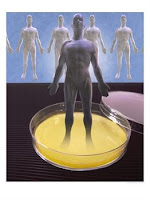 Mark Bedau, chief operating officer of ProtoLife of Venice, Italy, said, "Creating protocells has the potential to shed new light on our place in the universe. This will remove one of the few fundamental mysteries about creation in the universe and our role." Uh, yeah. Sure it will.
Exactly how will this "artificial" life be created? With the basic chemicals in DNA, of course.
Wait. You didn't think they were actually going to "create" life, did you? That's absurd! All true "scientists" will tell you that life can't be created; it can only evolve from what already existed.
Now, don't start asking where the stuff that already existed came from. Science means only dealing with what you can actually observe -- you know, like billions of years of evolution turning a primordial gumbo into the complex, blog-reading blob of organic tissue that is you. Speculating or theorizing based on actual evidence is something only religious crackpots do.
At any rate, here's what we can look forward to in the near future:
Now, when scientists are able to simply speak something into existence -- that is, without cheating by using something that has already been created -- then that might be newsworthy. In the meantime, I'm a little more concerned about the "artificial" life in my refrigerator.
 Mark Bedau, chief operating officer of ProtoLife of Venice, Italy, said, "Creating protocells has the potential to shed new light on our place in the universe. This will remove one of the few fundamental mysteries about creation in the universe and our role." Uh, yeah. Sure it will.
Exactly how will this "artificial" life be created? With the basic chemicals in DNA, of course.
Wait. You didn't think they were actually going to "create" life, did you? That's absurd! All true "scientists" will tell you that life can't be created; it can only evolve from what already existed.
Now, don't start asking where the stuff that already existed came from. Science means only dealing with what you can actually observe -- you know, like billions of years of evolution turning a primordial gumbo into the complex, blog-reading blob of organic tissue that is you. Speculating or theorizing based on actual evidence is something only religious crackpots do.
At any rate, here's what we can look forward to in the near future:
- One of the leaders in the field, Jack Szostak at Harvard Medical School, predicts that within the next six months, scientists will report evidence that the first step -- creating a cell membrane -- is "not a big problem." Scientists are using fatty acids in that effort.
Szostak is also optimistic about the next step—getting nucleotides, the building blocks of DNA, to form a working genetic system.
His idea is that once the container is made, if scientists add nucleotides in the right proportions, then Darwinian evolution could simply take over.
"We aren't smart enough to design things, we just let evolution do the hard work and then we figure out what happened," Szostak said.
Now, when scientists are able to simply speak something into existence -- that is, without cheating by using something that has already been created -- then that might be newsworthy. In the meantime, I'm a little more concerned about the "artificial" life in my refrigerator.
Subscribe to:
Posts (Atom)


 Posts
Posts


