
- Calvinism is on the rise, but so is Buddhism. It seems Americas "cross religious lines much more easily than political ones." And the author thinks that's a good thing.
- The five conundrums of Calvinism, according to Roger Olson. I would agree. If one insists on holding God to human standards, then, yes, these are conundrums.
- Thomas Schreiner on Calvinism and the warning passages in Hebrews.
- Don Bryant accuses John Piper of being "on the wrong side of cruel."
- One blogger writes, "If election has predetermined every man's fate, nothing anybody can do will change anything, so why try? This is the point of Calvinism, spiritual inactivity." I guess the writer assumes that sinful and rebellious men want to please God.
- Justin Taylor presents many different ways of reading through the Bible in 2012.
Friday, December 30, 2011
This Week in Calvinism - December 30, 2011


Friday, December 23, 2011
This Week in Calvinism - December 23, 2011
- Justin Taylor on the persecution of Christians in Kim Jong-Il's North Korea.
- The Society of Evangelical Arminians takes issue with Justin's post:
It is simply baffling that Calvinists can decry the diabolical, heinous actions of Kim Jong-Il (and others like him), and yet they hold that God first conceived in his own divine heart every one of the man's wicked actions, thought them up without any influence outside of himself, and unconditionally and irresistibly decreed them without any influence outside of himself, resulting in the man doing them all without any chance, power, or ability to do anything else. It's madness I tell you! Madness!!
What's madness is believing in the alternative: God creating a world in which people suffer the effects of evil without any meaning or purpose.
- Shocker. An Arminian considers Roger Olson's latest book, Against Calvinism, to be "an accurate assessment and successful critique" of Calvinism.
- Jeremy Walker explores New Calvinism's caveats and characteristics, notes its commendations, discusses some cautions and concerns, and offers his conclusions and counsels.
Friday, December 16, 2011
This Week in Calvinism - December 16, 2011
- Preacher-teacher Joel Taylor recommends the book The Truth About New Calvinism as a way of combating the false teaching of men like John Piper, Al Mohler, and R. C. Sproul.
- Arminian Roger Olson recommends the book Predestination: The American Career of a Contentious Doctrine as an informative look at the debate over the controversial doctrine. He agrees with the author, saying, "[T]he debate over God's sovereignty in salvation cannot be settled merely or simply by collection of biblical evidence."
- Atheist John Loftus, ever the eloquent wordsmith, calls Calvinism "bull----."
- Pastor Andrew Davis describes the reform of his Baptist church.
- John Piper on the origin of Calvinism.
- Evidences of God's grace in the church today.
Friday, December 09, 2011
This Week in Calvinism - December 9, 2011
- Peter Berger predicts, "If Calvinism is to make further inroads among Southern Baptists or among any other segments of American Evangelicals, it will be in its Arminian form." Huh?
- How does one strike a balance between Calvinism and Arminianism? Bob Hadley, Pastor of Westside Baptist Church in Daytona Beach, Florida, suggests a new TULIP acrostic: Total Lostness, Unconditional Love, Limiting Atonement, Irrefutable Gospel, Perseverance of the Savior.
- Beware of self-righteous Calvinism.
- Charles Spurgeon on evolution.
- Some book gift ideas from Desiring God.
Friday, December 02, 2011
This Week in Calvinism - December 2, 2011
- Are you recovering from Calvinism? There's help.
- A list of readings on the subject of divine sovereignty and human responsibility.
- Brenda Nickel warns of Rick Warren's move toward that "powerful deception" known as Calvinism.
- England was engulfed in civil war in the 1600s. Was the rise of Puritanism to blame, or could it have been the Arminian plot to overthrow Calvinism?
- Is Luke 10:13 more problematic for Calvinists or Molinists? Seeing as how God ordains the end and the means, I don't know of any Calvinists who have a problem with it, so I guess it would have to be Molinists.
Friday, November 25, 2011
This Week in Calvinism - November 25, 2011
- If you want to know the significance of Christianity in American history, study the Great Awakening.
- Joel Taylor recommends an audio series that exposes the false teachings of Mark Driscoll, John Piper, John MacArthur, Alistair Begg, R. C. Sproul, and others.
- Dan Corner refutes the "Calvinistic doctrine of infant damnation for the non-elect." Funny, I don't even remember being taught that.
- A "negative" review of God's Wisdom in Proverbs, a book by Pyromaniac Dan Phillips.
- Tim Challies has some great Black Friday deals for the discerning reader.
Tuesday, November 22, 2011
Man fired for not accepting the "mark of the beast"
Well...sort of.
 Billy E. Hyatt was recently fired from his job at a plastics factory near Dalton, Georgia. He claims it was because he refused to wear a sticker celebrating the factory being accident-free for 666 days.
It isn't clear whether management required the sticker to be worn on the forehead or on the hand, but Hyatt, a devout Christian (and apparently a devout dispensationalist), didn't want to take any chances. He believed that wearing the sticker would have been accepting the "mark of the beast" described in the book of Revelation, condemning him to hell.
Without getting into the serious implications of dispensational theology (though I think we're seeing one of them here), all of this hassle could have been avoided had Mr. Hyatt simply dropped a hammer on his toe. That would have bought him at least another 665 days.
It isn't clear whether management required the sticker to be worn on the forehead or on the hand, but Hyatt, a devout Christian (and apparently a devout dispensationalist), didn't want to take any chances. He believed that wearing the sticker would have been accepting the "mark of the beast" described in the book of Revelation, condemning him to hell.
Without getting into the serious implications of dispensational theology (though I think we're seeing one of them here), all of this hassle could have been avoided had Mr. Hyatt simply dropped a hammer on his toe. That would have bought him at least another 665 days.
Friday, November 18, 2011
This Week in Calvinism - November 18, 2011
- Randal Rauser's mistake: A defense of the doctrine of election.
- Bruce Bauer laments "Calvinism's 'god' of limited sovereignty."
- So...consistent Calvinists must conclude that all babies go to hell?
- R. C. Sproul Jr. discusses the topic of where babies go when they die.
- Michael Horton addresses Roger Olson's ridiculous charge that Calvinism makes God a "moral monster."
- When people attack Calvinists, it isn't just because they fail to understand our doctrine; they may not even understand their own.
Tuesday, November 15, 2011
Did God Tell Herman Cain to Run for President?

Herman Cain returned to his home state for a brief campaign stop Saturday, telling a cheering group of young Republicans in Atlanta that God told him to run for president and that he was "in it to win it."So what should I do if God told me not to vote for any candidate who claims to have been told by God to run for president?
"I prayed and prayed and prayed. I am a man of faith," Cain told the Young Republican National Federation at the Westin Peachtree Plaza. "I had to do a lot of praying for this one, more praying than I have ever done before in my life. And when I finally realized that it was God saying that this is what I needed to do, I was like Moses: 'You have got the wrong man, Lord. Are you sure?' ... Once I made the decision, I did not look back."
Friday, November 11, 2011
This Week in Calvinism - November 11, 2011
- For those wondering why Roger Olson didn't mention J. I. Packer in his book Against Calvinism, don't worry. He's against him, too.
- Speaking of Roger "I can't distinguish the God of Calvinism from the devil" Olson, James White reviews Against Calvinism (part 1, part 2). It ain't pretty.
- One pastor's biggest fear about members of his congregation reading The Purpose Driven Life: that they might "become caught up in the Calvinism that undergirds the book's assumptions."
- The tragic hypocrisy of joyless Calvinism.
Saturday, November 05, 2011

Friday, November 04, 2011
This Week in Calvinism - November 4, 2011
- Paul Manata reviews Roger Olson's book Against Calvinism.
- Who's to blame for the rise of Calvinism? Arminians, says The Seeking Disciple.
- A Calvinist response to the charge that Calvinism's God is a moral monster.
- How to call for a Gospel response like a Calvinist.
- What does the World Series have to do with the Cross?
Thursday, November 03, 2011


Monday, October 31, 2011
494 Years Ago Today
Disputation on the Power and Efficacy of Indulgences
Commonly Known as The 95 Theses
by Martin Luther
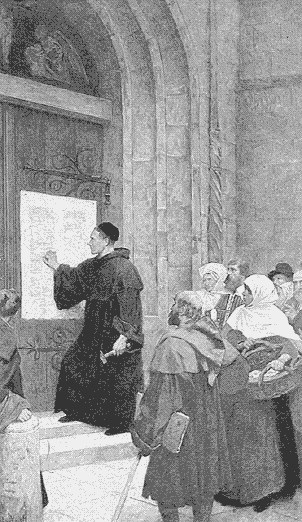 Out of love and concern for the truth, and with the object of eliciting it, the following heads will be the subject of a public discussion at Wittenberg under the presidency of the reverend father, Martin Luther, Augustinian, Master of Arts and Sacred Theology, and duly appointed Lecturer on these subjects in that place. He requests that whoever cannot be present personally to debate the matter orally will do so in absence in writing.
1. When our Lord and Master, Jesus Christ, said "Repent", He called for the entire life of believers to be one of repentance.
2. The word cannot be properly understood as referring to the sacrament of penance, i.e. confession and satisfaction, as administered by the clergy.
3. Yet its meaning is not restricted to repentance in one's heart; for such repentance is null unless it produces outward signs in various mortifications of the flesh.
4. As long as hatred of self abides (i.e. true inward repentance) the penalty of sin abides, viz., until we enter the kingdom of heaven.
5. The pope has neither the will nor the power to remit any penalties beyond those imposed either at his own discretion or by canon law.
6. The pope himself cannot remit guilt, but only declare and confirm that it has been remitted by God; or, at most, he can remit it in cases reserved to his discretion. Except for these cases, the guilt remains untouched.
7. God never remits guilt to anyone without, at the same time, making him humbly submissive to the priest, His representative.
8. The penitential canons apply only to men who are still alive, and, according to the canons themselves, none applies to the dead.
9. Accordingly, the Holy Spirit, acting in the person of the pope, manifests grace to us, by the fact that the papal regulations always cease to apply at death, or in any hard case.
10. It is a wrongful act, due to ignorance, when priests retain the canonical penalties on the dead in purgatory.
11. When canonical penalties were changed and made to apply to purgatory, surely it would seem that tares were sown while the bishops were asleep.
12. In former days, the canonical penalties were imposed, not after, but before absolution was pronounced; and were intended to be tests of true contrition.
13. Death puts an end to all the claims of the Church; even the dying are already dead to the canon laws, and are no longer bound by them.
14. Defective piety or love in a dying person is necessarily accompanied by great fear, which is greatest where the piety or love is least.
15. This fear or horror is sufficient in itself, whatever else might be said, to constitute the pain of purgatory, since it approaches very closely to the horror of despair.
16. There seems to be the same difference between hell, purgatory, and heaven as between despair, uncertainty, and assurance.
17. Of a truth, the pains of souls in purgatory ought to be abated, and charity ought to be proportionately increased.
18. Moreover, it does not seem proved, on any grounds of reason or Scripture, that these souls are outside the state of merit, or unable to grow in grace.
19. Nor does it seem proved to be always the case that they are certain and assured of salvation, even if we are very certain ourselves.
20. Therefore the pope, in speaking of the plenary remission of all penalties, does not mean "all" in the strict sense, but only those imposed by himself.
21. Hence those who preach indulgences are in error when they say that a man is absolved and saved from every penalty by the pope's indulgences.
22. Indeed, he cannot remit to souls in purgatory any penalty which canon law declares should be suffered in the present life.
23. If plenary remission could be granted to anyone at all, it would be only in the cases of the most perfect, i.e. to very few.
24. It must therefore be the case that the major part of the people are deceived by that indiscriminate and high-sounding promise of relief from penalty.
25. The same power as the pope exercises in general over purgatory is exercised in particular by every single bishop in his bishopric and priest in his parish.
26. The pope does excellently when he grants remission to the souls in purgatory on account of intercessions made on their behalf, and not by the power of the keys (which he cannot exercise for them).
27. There is no divine authority for preaching that the soul flies out of the purgatory immediately the money clinks in the bottom of the chest.
28. It is certainly possible that when the money clinks in the bottom of the chest avarice and greed increase; but when the church offers intercession, all depends in the will of God.
29. Who knows whether all souls in purgatory wish to be redeemed in view of what is said of St. Severinus and St. Pascal? (Note: Paschal I, pope 817-24. The legend is that he and Severinus were willing to endure the pains of purgatory for the benefit of the faithful).
30. No one is sure of the reality of his own contrition, much less of receiving plenary forgiveness.
31. One who bona fide buys indulgence is a rare as a bona fide penitent man, i.e. very rare indeed.
32. All those who believe themselves certain of their own salvation by means of letters of indulgence, will be eternally damned, together with their teachers.
33. We should be most carefully on our guard against those who say that the papal indulgences are an inestimable divine gift, and that a man is reconciled to God by them.
34. For the grace conveyed by these indulgences relates simply to the penalties of the sacramental "satisfactions" decreed merely by man.
35. It is not in accordance with Christian doctrines to preach and teach that those who buy off souls, or purchase confessional licenses, have no need to repent of their own sins.
36. Any Christian whatsoever, who is truly repentant, enjoys plenary remission from penalty and guilt, and this is given him without letters of indulgence.
37. Any true Christian whatsoever, living or dead, participates in all the benefits of Christ and the Church; and this participation is granted to him by God without letters of indulgence.
38. Yet the pope's remission and dispensation are in no way to be despised, for, as already said, they proclaim the divine remission.
39. It is very difficult, even for the most learned theologians, to extol to the people the great bounty contained in the indulgences, while, at the same time, praising contrition as a virtue.
40. A truly contrite sinner seeks out, and loves to pay, the penalties of his sins; whereas the very multitude of indulgences dulls men's consciences, and tends to make them hate the penalties.
41. Papal indulgences should only be preached with caution, lest people gain a wrong understanding, and think that they are preferable to other good works: those of love.
42. Christians should be taught that the pope does not at all intend that the purchase of indulgences should be understood as at all comparable with the works of mercy.
43. Christians should be taught that one who gives to the poor, or lends to the needy, does a better action than if he purchases indulgences.
44. Because, by works of love, love grows and a man becomes a better man; whereas, by indulgences, he does not become a better man, but only escapes certain penalties.
45. Christians should be taught that he who sees a needy person, but passes him by although he gives money for indulgences, gains no benefit from the pope's pardon, but only incurs the wrath of God.
46. Christians should be taught that, unless they have more than they need, they are bound to retain what is only necessary for the upkeep of their home, and should in no way squander it on indulgences.
47. Christians should be taught that they purchase indulgences voluntarily, and are not under obligation to do so.
48. Christians should be taught that, in granting indulgences, the pope has more need, and more desire, for devout prayer on his own behalf than for ready money.
49. Christians should be taught that the pope's indulgences are useful only if one does not rely on them, but most harmful if one loses the fear of God through them.
50. Christians should be taught that, if the pope knew the exactions of the indulgence-preachers, he would rather the church of St. Peter were reduced to ashes than be built with the skin, flesh, and bones of the sheep.
51. Christians should be taught that the pope would be willing, as he ought if necessity should arise, to sell the church of St. Peter, and give, too, his own money to many of those from whom the pardon-merchants conjure money.
52. It is vain to rely on salvation by letters of indulgence, even if the commissary, or indeed the pope himself, were to pledge his own soul for their validity.
53. Those are enemies of Christ and the pope who forbid the word of God to be preached at all in some churches, in order that indulgences may be preached in others.
54. The word of God suffers injury if, in the same sermon, an equal or longer time is devoted to indulgences than to that word.
55. The pope cannot help taking the view that if indulgences (very small matters) are celebrated by one bell, one pageant, or one ceremony, the gospel (a very great matter) should be preached to the accompaniment of a hundred bells, a hundred processions, a hundred ceremonies.
56. The treasures of the church, out of which the pope dispenses indulgences, are not sufficiently spoken of or known among the people of Christ.
57. That these treasures are not temporal are clear from the fact that many of the merchants do not grant them freely, but only collect them.
58. Nor are they the merits of Christ and the saints, because, even apart from the pope, these merits are always working grace in the inner man, and working the cross, death, and hell in the outer man.
59. St. Laurence said that the poor were the treasures of the church, but he used the term in accordance with the custom of his own time.
60. We do not speak rashly in saying that the treasures of the church are the keys of the church, and are bestowed by the merits of Christ.
61. For it is clear that the power of the pope suffices, by itself, for the remission of penalties and reserved cases.
62. The true treasure of the church is the Holy gospel of the glory and the grace of God.
63. It is right to regard this treasure as most odious, for it makes the first to be the last.
64. On the other hand, the treasure of indulgences is most acceptable, for it makes the last to be the first.
65. Therefore the treasures of the gospel are nets which, in former times, they used to fish for men of wealth.
66. The treasures of the indulgences are the nets to-day which they use to fish for men of wealth.
67. The indulgences, which the merchants extol as the greatest of favours, are seen to be, in fact, a favourite means for money-getting.
68. Nevertheless, they are not to be compared with the grace of God and the compassion shown in the Cross.
69. Bishops and curates, in duty bound, must receive the commissaries of the papal indulgences with all reverence.
70. But they are under a much greater obligation to watch closely and attend carefully lest these men preach their own fancies instead of what the pope commissioned.
71. Let him be anathema and accursed who denies the apostolic character of the indulgences.
72. On the other hand, let him be blessed who is on his guard against the wantonness and license of the pardon-merchant's words.
73. In the same way, the pope rightly excommunicates those who make any plans to the detriment of the trade in indulgences.
74. It is much more in keeping with his views to excommunicate those who use the pretext of indulgences to plot anything to the detriment of holy love and truth.
75. It is foolish to think that papal indulgences have so much power that they can absolve a man even if he has done the impossible and violated the mother of God.
76. We assert the contrary, and say that the pope's pardons are not able to remove the least venial of sins as far as their guilt is concerned.
77. When it is said that not even St. Peter, if he were now pope, could grant a greater grace, it is blasphemy against St. Peter and the pope.
78. We assert the contrary, and say that he, and any pope whatever, possesses greater graces, viz., the gospel, spiritual powers, gifts of healing, etc., as is declared in I Corinthians 12 [:28].
79. It is blasphemy to say that the insignia of the cross with the papal arms are of equal value to the cross on which Christ died.
80. The bishops, curates, and theologians, who permit assertions of that kind to be made to the people without let or hindrance, will have to answer for it.
81. This unbridled preaching of indulgences makes it difficult for learned men to guard the respect due to the pope against false accusations, or at least from the keen criticisms of the laity.
82. They ask, e.g.: Why does not the pope liberate everyone from purgatory for the sake of love (a most holy thing) and because of the supreme necessity of their souls? This would be morally the best of all reasons. Meanwhile he redeems innumerable souls for money, a most perishable thing, with which to build St. Peter's church, a very minor purpose.
83. Again: Why should funeral and anniversary masses for the dead continue to be said? And why does not the pope repay, or permit to be repaid, the benefactions instituted for these purposes, since it is wrong to pray for those souls who are now redeemed?
84. Again: Surely this is a new sort of compassion, on the part of God and the pope, when an impious man, an enemy of God, is allowed to pay money to redeem a devout soul, a friend of God; while yet that devout and beloved soul is not allowed to be redeemed without payment, for love's sake, and just because of its need of redemption.
85. Again: Why are the penitential canon laws, which in fact, if not in practice, have long been obsolete and dead in themselves,—why are they, to-day, still used in imposing fines in money, through the granting of indulgences, as if all the penitential canons were fully operative?
86. Again: since the pope's income to-day is larger than that of the wealthiest of wealthy men, why does he not build this one church of St. Peter with his own money, rather than with the money of indigent believers?
87. Again: What does the pope remit or dispense to people who, by their perfect repentance, have a right to plenary remission or dispensation?
88. Again: Surely a greater good could be done to the church if the pope were to bestow these remissions and dispensations, not once, as now, but a hundred times a day, for the benefit of any believer whatever.
89. What the pope seeks by indulgences is not money, but rather the salvation of souls; why then does he suspend the letters and indulgences formerly conceded, and still as efficacious as ever?
90. These questions are serious matters of conscience to the laity. To suppress them by force alone, and not to refute them by giving reasons, is to expose the church and the pope to the ridicule of their enemies, and to make Christian people unhappy.
91. If therefore, indulgences were preached in accordance with the spirit and mind of the pope, all these difficulties would be easily overcome, and indeed, cease to exist.
92. Away, then, with those prophets who say to Christ's people, "Peace, peace," where in there is no peace.
93. Hail, hail to all those prophets who say to Christ's people, "The cross, the cross," where there is no cross.
94. Christians should be exhorted to be zealous to follow Christ, their Head, through penalties, deaths, and hells.
95. And let them thus be more confident of entering heaven through many tribulations rather than through a false assurance of peace.
Commonly Known as The 95 Theses
by Martin Luther
Out of love and concern for the truth, and with the object of eliciting it, the following heads will be the subject of a public discussion at Wittenberg under the presidency of the reverend father, Martin Luther, Augustinian, Master of Arts and Sacred Theology, and duly appointed Lecturer on these subjects in that place. He requests that whoever cannot be present personally to debate the matter orally will do so in absence in writing.1. When our Lord and Master, Jesus Christ, said "Repent", He called for the entire life of believers to be one of repentance.
2. The word cannot be properly understood as referring to the sacrament of penance, i.e. confession and satisfaction, as administered by the clergy.
3. Yet its meaning is not restricted to repentance in one's heart; for such repentance is null unless it produces outward signs in various mortifications of the flesh.
4. As long as hatred of self abides (i.e. true inward repentance) the penalty of sin abides, viz., until we enter the kingdom of heaven.
5. The pope has neither the will nor the power to remit any penalties beyond those imposed either at his own discretion or by canon law.
6. The pope himself cannot remit guilt, but only declare and confirm that it has been remitted by God; or, at most, he can remit it in cases reserved to his discretion. Except for these cases, the guilt remains untouched.
7. God never remits guilt to anyone without, at the same time, making him humbly submissive to the priest, His representative.
8. The penitential canons apply only to men who are still alive, and, according to the canons themselves, none applies to the dead.
9. Accordingly, the Holy Spirit, acting in the person of the pope, manifests grace to us, by the fact that the papal regulations always cease to apply at death, or in any hard case.
10. It is a wrongful act, due to ignorance, when priests retain the canonical penalties on the dead in purgatory.
11. When canonical penalties were changed and made to apply to purgatory, surely it would seem that tares were sown while the bishops were asleep.
12. In former days, the canonical penalties were imposed, not after, but before absolution was pronounced; and were intended to be tests of true contrition.
13. Death puts an end to all the claims of the Church; even the dying are already dead to the canon laws, and are no longer bound by them.
14. Defective piety or love in a dying person is necessarily accompanied by great fear, which is greatest where the piety or love is least.
15. This fear or horror is sufficient in itself, whatever else might be said, to constitute the pain of purgatory, since it approaches very closely to the horror of despair.
16. There seems to be the same difference between hell, purgatory, and heaven as between despair, uncertainty, and assurance.
17. Of a truth, the pains of souls in purgatory ought to be abated, and charity ought to be proportionately increased.
18. Moreover, it does not seem proved, on any grounds of reason or Scripture, that these souls are outside the state of merit, or unable to grow in grace.
19. Nor does it seem proved to be always the case that they are certain and assured of salvation, even if we are very certain ourselves.
20. Therefore the pope, in speaking of the plenary remission of all penalties, does not mean "all" in the strict sense, but only those imposed by himself.
21. Hence those who preach indulgences are in error when they say that a man is absolved and saved from every penalty by the pope's indulgences.
22. Indeed, he cannot remit to souls in purgatory any penalty which canon law declares should be suffered in the present life.
23. If plenary remission could be granted to anyone at all, it would be only in the cases of the most perfect, i.e. to very few.
24. It must therefore be the case that the major part of the people are deceived by that indiscriminate and high-sounding promise of relief from penalty.
25. The same power as the pope exercises in general over purgatory is exercised in particular by every single bishop in his bishopric and priest in his parish.
26. The pope does excellently when he grants remission to the souls in purgatory on account of intercessions made on their behalf, and not by the power of the keys (which he cannot exercise for them).
27. There is no divine authority for preaching that the soul flies out of the purgatory immediately the money clinks in the bottom of the chest.
28. It is certainly possible that when the money clinks in the bottom of the chest avarice and greed increase; but when the church offers intercession, all depends in the will of God.
29. Who knows whether all souls in purgatory wish to be redeemed in view of what is said of St. Severinus and St. Pascal? (Note: Paschal I, pope 817-24. The legend is that he and Severinus were willing to endure the pains of purgatory for the benefit of the faithful).
30. No one is sure of the reality of his own contrition, much less of receiving plenary forgiveness.
31. One who bona fide buys indulgence is a rare as a bona fide penitent man, i.e. very rare indeed.
32. All those who believe themselves certain of their own salvation by means of letters of indulgence, will be eternally damned, together with their teachers.
33. We should be most carefully on our guard against those who say that the papal indulgences are an inestimable divine gift, and that a man is reconciled to God by them.
34. For the grace conveyed by these indulgences relates simply to the penalties of the sacramental "satisfactions" decreed merely by man.
35. It is not in accordance with Christian doctrines to preach and teach that those who buy off souls, or purchase confessional licenses, have no need to repent of their own sins.
36. Any Christian whatsoever, who is truly repentant, enjoys plenary remission from penalty and guilt, and this is given him without letters of indulgence.
37. Any true Christian whatsoever, living or dead, participates in all the benefits of Christ and the Church; and this participation is granted to him by God without letters of indulgence.
38. Yet the pope's remission and dispensation are in no way to be despised, for, as already said, they proclaim the divine remission.
39. It is very difficult, even for the most learned theologians, to extol to the people the great bounty contained in the indulgences, while, at the same time, praising contrition as a virtue.
40. A truly contrite sinner seeks out, and loves to pay, the penalties of his sins; whereas the very multitude of indulgences dulls men's consciences, and tends to make them hate the penalties.
41. Papal indulgences should only be preached with caution, lest people gain a wrong understanding, and think that they are preferable to other good works: those of love.
42. Christians should be taught that the pope does not at all intend that the purchase of indulgences should be understood as at all comparable with the works of mercy.
43. Christians should be taught that one who gives to the poor, or lends to the needy, does a better action than if he purchases indulgences.
44. Because, by works of love, love grows and a man becomes a better man; whereas, by indulgences, he does not become a better man, but only escapes certain penalties.
45. Christians should be taught that he who sees a needy person, but passes him by although he gives money for indulgences, gains no benefit from the pope's pardon, but only incurs the wrath of God.
46. Christians should be taught that, unless they have more than they need, they are bound to retain what is only necessary for the upkeep of their home, and should in no way squander it on indulgences.
47. Christians should be taught that they purchase indulgences voluntarily, and are not under obligation to do so.
48. Christians should be taught that, in granting indulgences, the pope has more need, and more desire, for devout prayer on his own behalf than for ready money.
49. Christians should be taught that the pope's indulgences are useful only if one does not rely on them, but most harmful if one loses the fear of God through them.
50. Christians should be taught that, if the pope knew the exactions of the indulgence-preachers, he would rather the church of St. Peter were reduced to ashes than be built with the skin, flesh, and bones of the sheep.
51. Christians should be taught that the pope would be willing, as he ought if necessity should arise, to sell the church of St. Peter, and give, too, his own money to many of those from whom the pardon-merchants conjure money.
52. It is vain to rely on salvation by letters of indulgence, even if the commissary, or indeed the pope himself, were to pledge his own soul for their validity.
53. Those are enemies of Christ and the pope who forbid the word of God to be preached at all in some churches, in order that indulgences may be preached in others.
54. The word of God suffers injury if, in the same sermon, an equal or longer time is devoted to indulgences than to that word.
55. The pope cannot help taking the view that if indulgences (very small matters) are celebrated by one bell, one pageant, or one ceremony, the gospel (a very great matter) should be preached to the accompaniment of a hundred bells, a hundred processions, a hundred ceremonies.
56. The treasures of the church, out of which the pope dispenses indulgences, are not sufficiently spoken of or known among the people of Christ.
57. That these treasures are not temporal are clear from the fact that many of the merchants do not grant them freely, but only collect them.
58. Nor are they the merits of Christ and the saints, because, even apart from the pope, these merits are always working grace in the inner man, and working the cross, death, and hell in the outer man.
59. St. Laurence said that the poor were the treasures of the church, but he used the term in accordance with the custom of his own time.
60. We do not speak rashly in saying that the treasures of the church are the keys of the church, and are bestowed by the merits of Christ.
61. For it is clear that the power of the pope suffices, by itself, for the remission of penalties and reserved cases.
62. The true treasure of the church is the Holy gospel of the glory and the grace of God.
63. It is right to regard this treasure as most odious, for it makes the first to be the last.
64. On the other hand, the treasure of indulgences is most acceptable, for it makes the last to be the first.
65. Therefore the treasures of the gospel are nets which, in former times, they used to fish for men of wealth.
66. The treasures of the indulgences are the nets to-day which they use to fish for men of wealth.
67. The indulgences, which the merchants extol as the greatest of favours, are seen to be, in fact, a favourite means for money-getting.
68. Nevertheless, they are not to be compared with the grace of God and the compassion shown in the Cross.
69. Bishops and curates, in duty bound, must receive the commissaries of the papal indulgences with all reverence.
70. But they are under a much greater obligation to watch closely and attend carefully lest these men preach their own fancies instead of what the pope commissioned.
71. Let him be anathema and accursed who denies the apostolic character of the indulgences.
72. On the other hand, let him be blessed who is on his guard against the wantonness and license of the pardon-merchant's words.
73. In the same way, the pope rightly excommunicates those who make any plans to the detriment of the trade in indulgences.
74. It is much more in keeping with his views to excommunicate those who use the pretext of indulgences to plot anything to the detriment of holy love and truth.
75. It is foolish to think that papal indulgences have so much power that they can absolve a man even if he has done the impossible and violated the mother of God.
76. We assert the contrary, and say that the pope's pardons are not able to remove the least venial of sins as far as their guilt is concerned.
77. When it is said that not even St. Peter, if he were now pope, could grant a greater grace, it is blasphemy against St. Peter and the pope.
78. We assert the contrary, and say that he, and any pope whatever, possesses greater graces, viz., the gospel, spiritual powers, gifts of healing, etc., as is declared in I Corinthians 12 [:28].
79. It is blasphemy to say that the insignia of the cross with the papal arms are of equal value to the cross on which Christ died.
80. The bishops, curates, and theologians, who permit assertions of that kind to be made to the people without let or hindrance, will have to answer for it.
81. This unbridled preaching of indulgences makes it difficult for learned men to guard the respect due to the pope against false accusations, or at least from the keen criticisms of the laity.
82. They ask, e.g.: Why does not the pope liberate everyone from purgatory for the sake of love (a most holy thing) and because of the supreme necessity of their souls? This would be morally the best of all reasons. Meanwhile he redeems innumerable souls for money, a most perishable thing, with which to build St. Peter's church, a very minor purpose.
83. Again: Why should funeral and anniversary masses for the dead continue to be said? And why does not the pope repay, or permit to be repaid, the benefactions instituted for these purposes, since it is wrong to pray for those souls who are now redeemed?
84. Again: Surely this is a new sort of compassion, on the part of God and the pope, when an impious man, an enemy of God, is allowed to pay money to redeem a devout soul, a friend of God; while yet that devout and beloved soul is not allowed to be redeemed without payment, for love's sake, and just because of its need of redemption.
85. Again: Why are the penitential canon laws, which in fact, if not in practice, have long been obsolete and dead in themselves,—why are they, to-day, still used in imposing fines in money, through the granting of indulgences, as if all the penitential canons were fully operative?
86. Again: since the pope's income to-day is larger than that of the wealthiest of wealthy men, why does he not build this one church of St. Peter with his own money, rather than with the money of indigent believers?
87. Again: What does the pope remit or dispense to people who, by their perfect repentance, have a right to plenary remission or dispensation?
88. Again: Surely a greater good could be done to the church if the pope were to bestow these remissions and dispensations, not once, as now, but a hundred times a day, for the benefit of any believer whatever.
89. What the pope seeks by indulgences is not money, but rather the salvation of souls; why then does he suspend the letters and indulgences formerly conceded, and still as efficacious as ever?
90. These questions are serious matters of conscience to the laity. To suppress them by force alone, and not to refute them by giving reasons, is to expose the church and the pope to the ridicule of their enemies, and to make Christian people unhappy.
91. If therefore, indulgences were preached in accordance with the spirit and mind of the pope, all these difficulties would be easily overcome, and indeed, cease to exist.
92. Away, then, with those prophets who say to Christ's people, "Peace, peace," where in there is no peace.
93. Hail, hail to all those prophets who say to Christ's people, "The cross, the cross," where there is no cross.
94. Christians should be exhorted to be zealous to follow Christ, their Head, through penalties, deaths, and hells.
95. And let them thus be more confident of entering heaven through many tribulations rather than through a false assurance of peace.
Subscribe to:
Posts (Atom)


 Posts
Posts


